
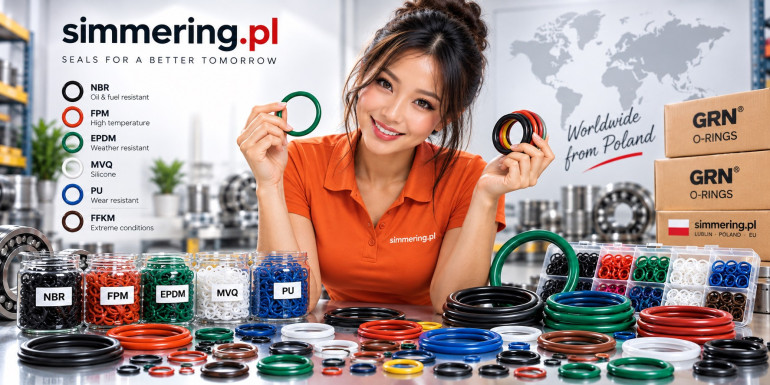
What are the best O-rings: NBR, FKM/FPM, EPDM, silicone VMQ, HNBR, FVMQ or FFKM?
There is no single O-ring material that is best for every application.
The best O-ring is the one whose material, compound, hardness, dimensions and properties match the fluid or gas, temperature, pressure, type of movement and groove design of the application.
This distinction matters.
A correctly selected NBR O-ring can be a better engineering choice than a much more expensive FKM O-ring in a standard mineral-oil application. In a high-temperature fuel system, the opposite may be true. EPDM may be an excellent choice for water and many HVAC applications but generally unsuitable for mineral oils. Silicone VMQ performs particularly well across a wide temperature range but is not automatically the best choice for demanding dynamic sealing.
So instead of asking:
“What is the best O-ring?”
ask:
“What is the best O-ring for my application?”
This guide compares NBR, FKM/FPM, EPDM, VMQ silicone, HNBR, FVMQ and FFKM O-rings and explains how to select O-rings for oil, fuel, water, high and low temperatures, hydraulics, pneumatics and demanding chemical environments.
What Is the Best O-Ring Material?
There is no universal winner.
O-rings may look simple, but reliable O-ring sealing depends on several parameters working together.
Important selection criteria include:
- fluid, gas or chemical medium,
- minimum operating temperature,
- maximum operating temperature,
- system pressure,
- static or dynamic operation,
- O-ring inside diameter,
- cross-section diameter,
- elastomer family,
- specific compound,
- hardness,
- extrusion gap,
- groove dimensions,
- O-ring compression or squeeze,
- stretch,
- surface finish,
- installation conditions,
- required approvals and certifications.
An O-ring can have exactly the correct dimensions and still fail rapidly if its material is incompatible with the operating medium.
For this reason:
FKM is not automatically better than NBR.
EPDM is not automatically better than FKM.
90 Shore A is not automatically better than 70 Shore A.
And the most expensive O-ring is not automatically the best.
The best O-ring is the one correctly engineered for the actual operating conditions.
Best O-Ring Material by Application – Quick Selection Table
| Application or operating condition | Material to consider first |
|---|---|
| Mineral oils | NBR |
| Mineral greases | NBR |
| General oil hydraulics | NBR |
| Oil at elevated temperature | HNBR or FKM depending on conditions |
| Many automotive fuels | FKM or application-specific compound |
| Water | Often EPDM |
| Hot water | Suitable EPDM compound |
| Steam | Special EPDM or another compound selected for actual conditions |
| Water/glycol systems | Often EPDM depending on composition |
| Outdoor applications | EPDM |
| Ozone exposure | EPDM |
| Very low temperatures | VMQ, FVMQ or special low-temperature compound |
| High temperatures | FKM, VMQ, FFKM or another material depending on the medium |
| General hydraulics | Often NBR or HNBR |
| Pneumatics | Often NBR |
| Aggressive chemicals | Compound selected for the specific chemical; FKM or FFKM in many demanding applications |
| Food contact | Specific approved compound |
| Drinking water | Specific approved compound |
| Extreme chemical resistance | FFKM in many applications |
| Fuel combined with low temperatures | FVMQ or specialist compounds depending on fuel |
This table should be used only for initial material screening.
It is not a substitute for checking the compatibility and operating limits of the specific compound.
Two O-rings described as NBR 70 can have different formulations and therefore different performance characteristics.
NBR O-Rings – The Best General-Purpose Choice for Oil?
NBR stands for nitrile butadiene rubber and is one of the most widely used elastomers for O-ring production.
Its popularity has a practical engineering basis.
NBR offers a useful combination of:
- resistance to many mineral oils,
- resistance to many mineral greases,
- good mechanical properties,
- good abrasion resistance in appropriate applications,
- wide industrial availability,
- competitive cost.
NBR O-rings are commonly found in:
- hydraulic systems,
- pneumatic equipment,
- industrial machinery,
- gearboxes,
- lubrication systems,
- mechanical equipment,
- automotive applications.
For many conventional mineral-oil applications, NBR should be one of the first materials considered.
However, NBR is not universal.
Standard NBR compounds have limitations when exposed to high temperatures, ozone, weathering and certain chemicals.
Why ACN Content Matters in NBR O-Rings
“NBR” does not describe one single rubber formulation.
NBR compounds can differ in their acrylonitrile content – ACN.
The ACN level affects the balance between properties such as oil and fuel resistance and low-temperature flexibility.
This has an important practical consequence.
Two O-rings can both be sold as:
NBR 70 Shore A
and still be made from different compounds with different performance characteristics.
Hardness alone does not identify an elastomer compound.
When an application is critical, selecting only by:
size + NBR + 70 Shore A
may not provide enough information.
FKM/FPM O-Rings – Best for Heat, Oil and Fuel?
FKM is a family of fluoroelastomers used extensively in demanding sealing applications.
The designation FPM is also commonly encountered, particularly in the European sealing industry.
FKM O-rings are widely used where the operating conditions require resistance to combinations of:
- elevated temperatures,
- oils,
- fuels,
- many chemicals,
- ageing,
- demanding industrial environments.
Typical applications include:
- engines,
- transmissions,
- fuel systems,
- industrial machinery,
- oil systems,
- automotive equipment,
- chemical processing equipment.
Is FKM Better Than NBR?
Not automatically.
Suppose an O-ring operates with a compatible mineral oil at a moderate temperature and the application is well within the capabilities of a suitable NBR compound.
In that case, NBR may be entirely appropriate.
FKM becomes particularly interesting when the application introduces factors such as:
- higher temperatures,
- fuels,
- more demanding chemicals,
- increased ageing resistance requirements,
- operating conditions outside the capabilities of the selected NBR compound.
But FKM also has limitations.
FKM is not chemically resistant to everything.
Choosing FKM simply because it is more expensive than NBR is not an engineering selection method.
The medium must always be identified first.
EPDM O-Rings – Best O-Rings for Water?
EPDM is one of the most important O-ring materials for applications involving water, weathering, ozone and many polar media.
Suitable EPDM compounds are commonly used in:
- water systems,
- heating systems,
- HVAC,
- pumps,
- sanitary equipment,
- water/glycol systems,
- outdoor equipment.
EPDM is particularly well known for its resistance to:
- water,
- weathering,
- ozone,
- ageing,
- many polar fluids.
Appropriately formulated EPDM compounds can also be used in demanding hot-water and steam applications.
Is EPDM Suitable for Oil?
This is one of the most important material-selection distinctions.
EPDM is generally not suitable for mineral oils and many petroleum-based fluids.
This illustrates why temperature ratings alone can be misleading.
An elastomer may tolerate the operating temperature but still be completely unsuitable because of chemical incompatibility with the medium.
For O-ring selection, the correct order is:
medium first, temperature second.
Silicone O-Rings – When Is VMQ the Best Choice?
VMQ silicone rubber is valued particularly for its performance over a wide temperature range and its ability to retain flexibility at low temperatures.
Silicone O-rings are used in applications including:
- instrumentation,
- electronics,
- industrial equipment,
- low-temperature systems,
- selected high-temperature applications.
However, silicone has different mechanical properties from NBR, HNBR and many FKM compounds.
It should therefore not automatically be considered the best choice for demanding dynamic applications or environments where high mechanical resistance is required.
Are Silicone O-Rings Food Grade?
Not automatically.
This is a common and potentially costly misconception.
Silicone is a material family. “Food grade” relates to the requirements and approvals applicable to a specific compound or finished product.
A silicone O-ring is therefore not automatically suitable for food-contact applications merely because it is made from VMQ.
The same principle applies to:
- NBR,
- EPDM,
- FKM,
- other elastomers.
When regulatory compliance is required, verify the documentation for the specific compound and product.
HNBR O-Rings – When Standard NBR Is Not Enough
HNBR stands for hydrogenated nitrile butadiene rubber.
It is used in applications where some of the useful characteristics associated with nitrile rubber are required together with improved performance in areas such as temperature, ageing and mechanical properties.
HNBR O-rings are found in:
- automotive systems,
- industrial machinery,
- hydraulic systems,
- oil-related applications,
- demanding mechanical systems.
HNBR can outperform standard NBR under certain operating conditions.
That does not mean it universally replaces either NBR or FKM.
The final decision still depends on the medium, temperature and mechanical conditions.
FVMQ O-Rings – Fluorosilicone for Fuel and Low Temperatures
FVMQ, or fluorosilicone rubber, combines some of the useful temperature characteristics of silicone with improved resistance to certain fuels and oils.
FVMQ can be particularly useful when an application combines:
- low temperatures,
- fuel or oil exposure,
- specialised performance requirements.
It is used in demanding applications, including some aerospace and transportation systems.
FVMQ is an excellent example of why the common question:
“NBR or FKM?”
does not always cover all realistic engineering options.
Sometimes the correct solution is neither.
FFKM O-Rings – The Best O-Rings for Aggressive Chemicals?
FFKM stands for perfluoroelastomer.
These materials occupy the high-performance end of elastomer sealing technology.
Appropriate FFKM compounds can provide exceptionally broad chemical resistance and high-temperature capability.
They are used in industries such as:
- chemical processing,
- semiconductor manufacturing,
- pharmaceutical processing,
- high-temperature process equipment,
- aggressive chemical environments.
Is FFKM the Best O-Ring Material?
Only when its properties are required.
An FFKM O-ring may be an excellent engineering solution in an extremely demanding chemical process.
Using the same material in a simple mineral-oil application at moderate temperature may provide little practical benefit compared with a correctly specified conventional elastomer.
The cost difference can be enormous.
Therefore:
the most technologically advanced O-ring is not automatically the best O-ring for every application.
Best O-Rings for Oil
For many applications involving conventional mineral oils, NBR is the logical starting point.
For more demanding operating conditions, engineers may consider:
- HNBR,
- FKM/FPM,
- application-specific compounds.
However, “oil” is not a sufficiently precise medium description for critical applications.
The following should be identified:
- exact oil type,
- base oil,
- additives,
- minimum temperature,
- maximum temperature,
- pressure,
- static or dynamic operation.
Hydraulic oil, engine oil, gearbox oil, synthetic lubricant and process oil should not automatically be treated as chemically identical media.
Best O-Rings for Fuel
FKM is widely used in fuel applications, but the word fuel covers very different chemical compositions.
An O-ring may be exposed to:
- petrol/gasoline,
- diesel,
- biofuel blends,
- aviation fuel,
- gaseous fuels,
- specialist fuel formulations.
Changes in fuel composition can affect elastomer compatibility.
For reliable selection, determine:
- the exact fuel,
- minimum temperature,
- maximum temperature,
- pressure,
- static or dynamic operating conditions.
Only then should the compound be selected.
Best O-Rings for Water
EPDM is frequently one of the first materials considered for water systems.
Typical applications include:
- plumbing,
- heating,
- HVAC,
- pumps,
- hot-water systems,
- selected water/glycol circuits.
However:
not every EPDM O-ring is approved for drinking water.
Where an application requires regulatory approval, verify the specific compound and product documentation.
The material name alone is insufficient.
Best O-Rings for High Temperature
A common search query is:
“What O-ring can withstand 150°C?”
The question is incomplete.
At 150°C, an O-ring might be exposed to:
- hot air,
- mineral oil,
- synthetic oil,
- fuel,
- water,
- steam,
- aggressive chemicals.
An elastomer that performs well in hot air may behave very differently in hot steam or a reactive chemical.
Therefore the correct question is:
“Which O-ring material is suitable for this medium at 150°C?”
Depending on the application, potential candidates can include:
- FKM,
- VMQ,
- HNBR,
- EPDM,
- FFKM,
- specialist compounds.
Temperature should never be evaluated in isolation.
Best O-Rings for Low Temperature
Low-temperature sealing presents a different challenge.
As temperature falls, elastomers can lose flexibility. This can reduce their ability to maintain sealing contact as components move or dimensions change.
Depending on the application, low-temperature candidates may include:
- low-temperature NBR compounds,
- VMQ,
- FVMQ,
- specialist elastomers.
The minimum temperature stated on a material chart should not be treated as the only selection criterion.
Medium compatibility and whether the seal operates statically or dynamically also matter.
Best O-Rings for Hydraulic Systems
NBR is one of the most widely used O-ring materials in conventional hydraulic systems operating with compatible mineral-based hydraulic fluids.
More demanding applications may require:
- HNBR,
- FKM,
- specialist compounds.
Hydraulic O-ring selection must also consider:
- system pressure,
- extrusion gap,
- O-ring hardness,
- groove geometry,
- dynamic movement,
- pressure cycling.
At high pressure, an O-ring can be forced into the clearance gap.
This failure mechanism is known as extrusion.
Depending on the system design, harder compounds and/or appropriately selected backup rings may be required.
Best O-Rings for Pneumatics
NBR is also widely used in pneumatic applications.
However, the correct selection depends on factors including:
- pressure,
- temperature,
- lubrication,
- speed,
- frequency of movement,
- groove design,
- friction requirements.
Dynamic pneumatic sealing should therefore not be reduced to selecting an O-ring solely by diameter.
NBR 70 vs NBR 90 Shore A – Which Is Better?
Neither hardness is universally better.
70 Shore A is extremely common for general-purpose O-rings.
90 Shore A is significantly harder and can be useful in selected high-pressure applications or where extrusion resistance is particularly important.
But:
90 Shore A does not mean higher quality.
A harder O-ring:
- deforms less easily,
- can be more difficult to install,
- may respond differently to surface imperfections,
- does not correct an incorrectly designed groove,
- is not automatically a solution to leakage.
Hardness is an engineering parameter, not a quality score.
Does O-Ring Colour Identify the Material?
No.
You should not identify an unknown O-ring solely by its colour.
A black O-ring can be made from different elastomers.
The same applies to:
- brown,
- green,
- red,
- blue,
- white,
- other colours.
Manufacturers may use colour to identify particular compounds or product families, but there is no universal worldwide rule stating:
one colour = one O-ring material.
For critical applications, use product identification and technical documentation.
How Can You Tell If an O-Ring Is Good Quality?
Appearance alone is not enough.
Two O-rings may look almost identical while having very different performance.
Important quality and selection factors include:
Dimensions and tolerances
The inside diameter and cross-section must comply with the requirements of the application.
Compound
“NBR” or “FKM” alone may not provide sufficient information for critical service.
The specific compound matters.
Hardness
Hardness should match the mechanical design and operating conditions.
Compression set
An O-ring works by controlled deformation.
If an elastomer loses too much of its ability to recover after prolonged compression, its sealing performance can deteriorate.
Chemical compatibility
An incompatible fluid can cause:
- swelling,
- shrinkage,
- softening,
- hardening,
- cracking,
- loss of mechanical properties.
Surface quality
Surface imperfections can affect sealing performance.
O-ring quality requirements and surface imperfections are addressed by standards including the ISO 3601 series.
Why Do O-Rings Fail?
An O-ring can fail even when its nominal dimensions are correct.
Common causes include:
- incorrect elastomer,
- incorrect compound,
- chemical incompatibility,
- excessive temperature,
- incorrect hardness,
- excessive pressure,
- extrusion,
- incorrect groove dimensions,
- excessive clearance,
- incorrect squeeze,
- excessive stretch,
- twisting during installation,
- cutting on sharp edges,
- contamination,
- incorrect installation lubricant,
- dynamic wear,
- ageing.
A failed O-ring should not always be thrown away immediately.
Its failure pattern can provide useful diagnostic information.
Why Does an O-Ring Leak Even After Replacement?
Replacing an old O-ring with a new one of exactly the same size does not guarantee that the problem has been solved.
If leakage returns, investigate:
- groove condition,
- shaft or bore surface,
- actual O-ring compound,
- operating temperature,
- pressure,
- fluid compatibility,
- installation damage,
- extrusion,
- compression set.
Repeated O-ring failure often indicates an application problem rather than simply a defective seal.
How to Measure an O-Ring
The two fundamental O-ring dimensions are:
d1 – inside diameter
and
d2 – cross-section diameter
For example:
O-ring 20x3 mm
means an O-ring with:
- 20 mm inside diameter,
- 3 mm cross-section diameter.
Measuring a used O-ring can be misleading.
An old seal may have:
- stretched,
- flattened,
- swollen,
- shrunk,
- permanently deformed.
For critical identification, groove dimensions and the original sealing design can provide more reliable information than copying the dimensions of a damaged O-ring.
O-Ring Standards – Why ISO 3601 Matters
The ISO 3601 series is one of the key international standards associated with O-rings.
Important parts include:
ISO 3601-1
Covers O-ring inside diameters, cross-sections, tolerances and designation codes.
ISO 3601-2
Covers housing dimensions for general applications.
Groove design is critical because even an excellent O-ring compound cannot compensate for fundamentally incorrect housing geometry.
ISO 3601-3
Covers quality acceptance criteria and surface imperfections.
Other dimensional systems are also used internationally, including AS568 sizes widely associated with inch-based O-rings.
Standards help define dimensions and quality requirements, but:
dimensional compliance does not replace material selection.
An O-ring can have exactly the correct standard dimensions and still be chemically incompatible with the application.
O-Ring Size vs O-Ring Material – Which Matters More?
Both.
Selecting the correct material but wrong dimensions will not produce a reliable seal.
Selecting the correct dimensions but wrong material can fail just as quickly.
Reliable O-ring selection requires both:
correct geometry + correct material
and, in demanding applications:
correct geometry + correct compound + correct hardness + correct operating conditions.
Common O-Ring Selection Mistakes
“The old O-ring was black, so I need a black one.”
Colour does not reliably identify the material.
“FKM costs more, so it must be better.”
Not for every medium or temperature.
“Silicone means food grade.”
No. Required approvals must apply to the specific compound or product.
“The dimensions are correct, so it will work.”
Dimensions are only part of the selection.
“90 Shore A is better than 70 Shore A.”
It is harder, not automatically better.
“This material can withstand 200°C, so it will work in my system at 150°C.”
Not necessarily. Medium compatibility must also be checked.
“All NBR 70 O-rings are basically the same.”
They are not.
Different NBR compounds can have different formulations and performance.
How to Choose the Best O-Ring – 10-Step Selection Process
1. Determine the O-ring dimensions
Identify the required inside diameter and cross-section.
2. Identify the exact medium
Avoid vague descriptions such as “oil” or “chemical” whenever possible.
3. Determine minimum and maximum temperature
Use actual operating extremes, not only normal operating temperature.
4. Determine pressure
Pressure affects sealing behaviour and extrusion risk.
5. Identify static or dynamic operation
Dynamic seals have additional friction and wear requirements.
6. Select the elastomer family
Compare NBR, HNBR, FKM, EPDM, VMQ, FVMQ, FFKM or other materials.
7. Select the specific compound
Do not stop at the material-family level for critical applications.
8. Select the appropriate hardness
Hardness must correspond to pressure, clearance, groove design and operating conditions.
9. Check groove design
The housing must provide appropriate squeeze, stretch and available volume.
10. Verify standards, approvals and technical documentation
For regulated or critical applications, documentation should be part of the selection process.
Which O-Ring Material Is Best? NBR vs FKM vs EPDM vs VMQ
| Property / Application | NBR | FKM/FPM | EPDM | VMQ Silicone |
|---|---|---|---|---|
| Mineral oils | Very commonly used | Very commonly used | Generally unsuitable | Application-dependent |
| Fuels | Compound-dependent | Frequently used | Generally unsuitable for petroleum fuels | Limited; FVMQ may be more appropriate |
| Water | Application-dependent | Application-dependent | Frequently used | Application-dependent |
| Hot water | Limited by compound and conditions | Application-dependent | Frequently used with suitable compound | Application-dependent |
| Ozone/weathering | Limited compared with EPDM | Good | Excellent | Very good |
| Low temperature | Compound-dependent | Compound-dependent | Compound-dependent | Major strength |
| High temperature | Limited compared with FKM | Major strength | Compound/application-dependent | Major strength |
| Dynamic mechanical use | Frequently used | Frequently used | Application-dependent | More limited in demanding dynamic service |
| Cost | Usually economical | Higher | Usually moderate | Usually higher than standard NBR |
This comparison intentionally avoids universal temperature numbers because the performance limits belong to the specific compound, not simply to the three-letter material abbreviation.
FAQ – Best O-Rings and O-Ring Materials
What is the best O-ring for oil?
For many conventional mineral-oil applications, NBR is the first material to consider. HNBR or FKM may be appropriate when temperature or other operating requirements exceed the capabilities of the selected NBR compound.
What is the best O-ring for fuel?
FKM is widely used for many fuel applications. However, fuel composition, temperature and operating conditions must be known before selecting the final compound.
What is the best O-ring for water?
EPDM is commonly used in water systems. For drinking-water applications, verify that the specific compound has the required approval.
What is the best O-ring for high temperature?
There is no single answer. FKM, VMQ, FFKM, HNBR, EPDM and specialist compounds can all be candidates depending on the temperature and medium.
Is NBR better than FKM?
Neither is universally better. NBR is an excellent material for many conventional oil applications. FKM provides advantages in many higher-temperature, fuel and chemically demanding environments.
Is FKM better than EPDM?
They are designed for different chemical environments. FKM is frequently used with oils and fuels, while EPDM is widely used with water, weathering and many polar fluids.
Is EPDM better than NBR?
For water and weathering, EPDM may have important advantages. For many mineral oils, NBR is generally more appropriate.
What is the difference between FKM and FPM?
Both terms are used for fluoroelastomer materials. FKM is widely used internationally, while FPM is still frequently encountered in the European sealing industry.
What is the best O-ring hardness?
There is no universal best hardness. 70 Shore A is common for general applications, while harder compounds such as 90 Shore A are used where operating conditions and seal design require them.
Are silicone O-rings food safe?
Not automatically. Food-contact suitability must be established for the specific compound and applicable regulatory requirements.
Can I replace an NBR O-ring with FKM?
Sometimes, but the substitution should not be made solely because FKM is considered a higher-performance material. Check chemical compatibility, temperature, mechanical requirements and the specific compound.
Why does my new O-ring leak?
Possible causes include the wrong compound, installation damage, incorrect groove dimensions, insufficient or excessive squeeze, extrusion, chemical incompatibility, excessive temperature or surface damage.
Are all NBR 70 O-rings the same?
No. The same material family and hardness do not guarantee the same compound formulation or performance.
Does O-ring colour indicate material?
No. Colour should not be used as a universal material-identification system.
What do the numbers in an O-ring size mean?
For a metric O-ring described as 20x3 mm, 20 mm normally refers to the inside diameter and 3 mm to the cross-section diameter.
Best O-Rings – The Final Selection Rule
There is no O-ring material that is simultaneously the best choice for oil, fuel, water, steam, aggressive chemicals, extreme heat and extreme cold.
For many conventional mineral-oil applications, NBR is a logical starting point.
For higher temperatures, many fuels and demanding chemical environments, FKM/FPM is often considered.
For water, HVAC, weathering and ozone resistance, EPDM is frequently used.
For applications where low-temperature flexibility is particularly important, VMQ silicone may be considered.
More demanding applications can require HNBR, FVMQ, FFKM or specialised elastomer compounds.
The most useful selection sequence is:
medium -> temperature -> pressure -> static or dynamic operation -> groove design -> elastomer family -> specific compound -> hardness -> dimensions and tolerances.
Only after these factors are known can an O-ring be meaningfully described as the best O-ring for a particular application.
A small O-ring can determine the reliability of a machine, hydraulic system, pump, gearbox or process installation worth thousands of times more than the seal itself.
That is why O-ring selection should never be reduced to:
“It looks the same and the dimensions match.”
At simmering.pl, O-rings and industrial sealing solutions are supplied from stock in Poland, with worldwide shipping available.

Leave a Reply Cancel Reply