
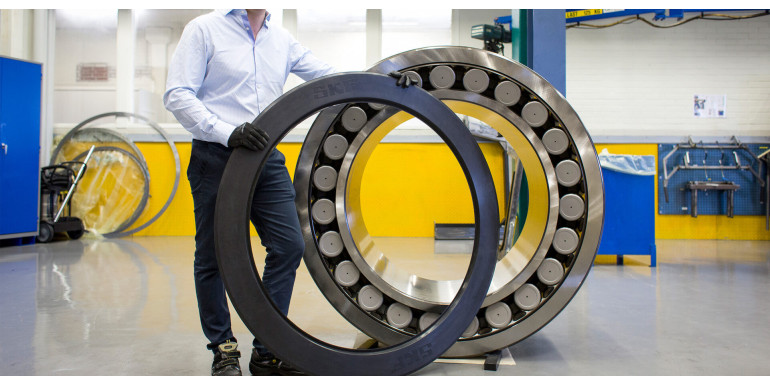
SKF deep groove ball bearings are among the most widely used types of rolling bearings. They are found in electric motors, pumps, fans, gearboxes, industrial machinery, agricultural equipment and many other applications involving rotating shafts.
Their popularity comes from a relatively simple design, low friction, suitability for high rotational speeds and the ability to accommodate radial loads as well as appropriate axial loads in both directions.
However, an SKF bearing should not be selected by dimensions alone. Designations such as 2Z, 2RSH, 2RSL, C3, C4, TN9 and HC5 identify important design characteristics that can determine whether a particular bearing is suitable for a specific application.
How Is an SKF Deep Groove Ball Bearing Constructed?
A typical single-row deep groove ball bearing consists of:
- Inner ring
- Outer ring
- Balls
- Cage that separates and guides the rolling elements
- Optional shields or seals
The deep raceway grooves in the inner and outer rings enable the bearing to accommodate primarily radial loads, while its geometry also allows appropriate axial loads in both directions.
Deep groove ball bearings are therefore highly versatile, but the specific bearing version must still be matched to operating load, speed, temperature, contamination, lubrication and required service life.
What Do the 6000, 6200 and 6300 Series Mean?
The basic bearing designation identifies the bearing type and dimensional series.
Common SKF deep groove ball bearing series include:
6000 series - relatively light cross-section designs
6200 series - widely used general-purpose dimensional series
6300 series - larger cross-section designs with different load-carrying characteristics
For example:
6005 - deep groove ball bearing with a 25 mm bore
6205 - also has a 25 mm bore, but different outside dimensions
6305 - also has a 25 mm bore but belongs to another dimensional series
A bearing therefore cannot be selected based only on shaft diameter.
At minimum, verify:
d - bore diameter
D - outside diameter
B - bearing width
How to Read an SKF Bearing Designation
A complete SKF bearing designation can contain a basic designation together with additional prefixes and suffixes.
For example:
6205-2RSH/C3
can be interpreted as:
6205 - basic deep groove ball bearing designation
2RSH - contact seals on both sides
C3 - radial internal clearance greater than Normal
Two bearings with identical principal dimensions are therefore not necessarily equivalent if they have different seals, internal clearances, cages, lubricants or other design characteristics.
What Does 2Z Mean on an SKF Bearing?
The designation 2Z indicates that the bearing has metal shields on both sides.
Example:
6205-2Z SKF
The shields help limit the ingress of certain contaminants and retain lubricant inside the bearing.
An important characteristic of shielded designs is their relatively low influence on running friction.
2Z bearings are commonly considered for applications where relatively high rotational speeds are important and contact sealing is not required.
What Does SKF 2RSH Mean?
2RSH indicates contact seals on both sides of the bearing.
These seals are designed to provide more effective protection of the bearing interior against contamination while also helping retain lubricant.
Compared with 2Z metal shields, contact seals provide a different balance between protection and friction.
The choice between 2Z and 2RSH should therefore be based on operating conditions rather than product availability alone.
SKF 2RSL - Low-Friction Seals
The designation 2RSL identifies bearings equipped with low-friction seals on both sides.
This design provides a balance between protecting the bearing interior and limiting the additional friction associated with sealing.
The difference between 2Z, 2RSL and 2RSH can be particularly important in applications involving high speeds, specific contamination conditions or demanding lubricant-life requirements.
2Z vs 2RSL vs 2RSH - Which Version Should You Choose?
There is no single sealing solution that is best for every application.
2Z can be considered where low running resistance is important and the operating environment does not require contact sealing.
2RSL is designed to provide sealing performance while maintaining relatively low seal friction.
2RSH uses contact seals and can be selected where greater protection against external contamination is required.
Before replacing one version with another, always verify the requirements of the machine and application.
What Does C3 Mean on an SKF Bearing?
C3 does not indicate the quality grade of a bearing.
It identifies radial internal clearance greater than Normal.
For example:
6205-2RSH/C3 SKF
is a 6205 bearing with 2RSH seals on both sides and C3 internal clearance.
Greater initial clearance can be required when operating conditions or mounting arrangements reduce the internal clearance during operation, for example because of interference fits or temperature differences.
This does not mean that C3 is automatically better than Normal clearance.
Internal clearance must be selected for the specific application.
C3 vs C4 - What Is the Difference?
Both C3 and C4 indicate internal clearance greater than Normal.
In simplified terms:
C3 - greater clearance than Normal
C4 - greater clearance than C3
Using a C4 bearing where Normal or C3 clearance is specified should not be treated as an automatic upgrade.
Incorrect internal clearance can affect rolling-element operating conditions, vibration, noise and bearing service life.
What Does TN9 Mean?
TN9 identifies a particular SKF cage design.
In SKF bearing designations, TN9 can refer to a cage manufactured from glass-fibre-reinforced PA66 polyamide.
Cage design and material can be relevant when evaluating operating temperature, rotational speed and lubricant compatibility.
For this reason, the TN9 suffix should not automatically be ignored when selecting a replacement bearing.
What Does HC5 Mean on SKF Bearings?
The HC5 designation can be found on specialized SKF hybrid bearings.
Hybrid bearing designs combine ceramic rolling elements with steel rings.
An example of a more complex SKF designation is:
6004-2RSLTN9/HC5C3WT
Such a designation communicates considerably more information about the bearing than the basic designation 6004 alone.
A hybrid bearing should therefore not automatically be treated as equivalent to a conventional all-steel bearing simply because both products have the same principal dimensions.
Why Is the Complete Bearing Designation Important?
Consider a user searching for:
6007-2RZTN9/HC5C3WT
Searching only for 6007 does not identify the complete bearing configuration.
Individual parts of the designation communicate additional information about the bearing design and specification.
Ignoring these suffixes can result in selecting a bearing with the same principal dimensions but different operating characteristics.
Whenever possible, copy the complete designation from the bearing ring or original packaging.
Are Bearings with the Same Dimensions Always Interchangeable?
No.
Identical d x D x B dimensions are only the starting point when evaluating interchangeability.
Before selecting a replacement, verify:
- Complete bearing designation
- Bearing type and design
- Open, shielded or sealed configuration
- Internal clearance
- Cage design when relevant
- Speed requirements
- Applied loads
- Operating temperature
- Lubrication conditions
- Machine manufacturer's requirements
Specialized applications may also require verification of additional design features identified by manufacturer-specific suffixes.
What Is SKF Explorer?
SKF Explorer should not be treated simply as a marketing term applied to every SKF bearing.
It is a performance class used by SKF for specified product groups.
For applicable deep groove ball bearings, SKF Explorer designs incorporate developments intended to improve aspects such as load-carrying capability, friction, operating temperature, lubricant life, noise and vibration.
Not every SKF bearing is necessarily an SKF Explorer bearing. The specification should be verified for the individual bearing designation.
What Are SKF Energy Efficient E2 Bearings?
SKF has also developed Energy Efficient bearings identified by E2, designed to reduce frictional losses.
For specific E2 bearing designs and operating conditions, SKF has published reductions in frictional moment compared with corresponding reference bearing designs.
E2 should not, however, be considered a universal replacement for every standard bearing.
These bearings were developed for specific operating ranges and requirements, including defined loads and speeds.
Where Are SKF Deep Groove Ball Bearings Used?
Deep groove ball bearings are widely used in:
- Electric motors
- Pumps
- Fans
- Conveyors
- Gearboxes
- Power tools
- Industrial machinery
- HVAC equipment
- Agricultural machinery
- Household appliances
- Other rotating mechanical assemblies
Whether a particular bearing is suitable depends on the actual operating conditions rather than simply the type of machine.
How to Select an SKF Bearing
The safest starting point is the complete designation of the existing bearing.
If the designation cannot be identified, determine the following:
1. Bearing type
Identify whether the component is a deep groove ball bearing, angular contact bearing, self-aligning bearing, cylindrical roller bearing or another design.
2. Principal dimensions
Measure the bore diameter d, outside diameter D and width B.
3. Closure type
Check whether the bearing is open, shielded or sealed.
4. Internal clearance
Look for designations such as C3 or C4.
5. Additional suffixes
Do not ignore suffixes identifying cage design, rolling-element material, lubricant or other construction details.
6. Operating conditions
Consider load, rotational speed, temperature, contamination and the machine manufacturer's requirements.
How to Search for an SKF Bearing by Designation
For technical bearings, searching by the complete catalogue designation is usually the most precise method.
If the existing bearing is marked:
6205-2RSH/C3
search for the complete designation rather than simply entering 6205 SKF.
The same principle applies to more complex bearing codes.
Using the complete designation reduces the risk of finding a bearing with matching dimensions but a different technical configuration.
Common Mistakes When Selecting a Bearing
One of the most common mistakes is choosing a bearing based only on its dimensions.
Other frequent mistakes include:
- Ignoring C3 or C4 clearance
- Treating 2Z and 2RSH as identical configurations
- Omitting important suffixes
- Assuming greater internal clearance means a better bearing
- Selecting a replacement based only on shaft diameter
- Ignoring operating temperature and rotational speed
- Ignoring contamination conditions
If the original bearing designation is available, record and compare it in full.
How to Identify the Correct SKF Bearing
Before purchasing a replacement bearing, compare:
complete designation + dimensions + sealing arrangement + internal clearance + additional suffixes
This provides a much stronger basis for evaluating compatibility than simply looking for a bearing described as, for example, 25x52x15 mm.
Where the machine manufacturer specifies a particular bearing configuration, the machine documentation should also be taken into account.
SKF Bearings at simmering.pl
At simmering.pl, SKF bearings can be searched by designation, dimensions and bearing design.
When searching for a specific catalogue number, use the complete bearing designation, particularly when it contains suffixes such as:
2Z, 2RSH, 2RSL, C3, C4, TN9, HC5 or WT.
Using the complete designation helps narrow search results to the appropriate configuration instead of searching only by dimensional series.
Current availability, price and dispatch information should always be checked on the individual product page.
FAQ - SKF Deep Groove Ball Bearings
What does 2Z mean on an SKF bearing?
2Z indicates metal shields on both sides of the bearing.
What does 2RSH mean?
2RSH indicates contact seals on both sides of the bearing.
What does C3 mean?
C3 indicates radial internal clearance greater than Normal. It is not a bearing quality designation.
Does C4 have greater clearance than C3?
Yes. C4 internal clearance is greater than C3.
Are 2Z and 2RSH the same?
No. 2Z uses metal shields, while 2RSH identifies contact seals.
Is every SKF bearing an SKF Explorer bearing?
No. SKF Explorer is a defined performance class used for specified SKF product groups and bearing designs.
Are two 25x52x15 mm bearings always interchangeable?
No. Matching dimensions do not guarantee identical specifications. Bearing type, seals, internal clearance and additional suffixes should also be compared.
Is C3 better than Normal clearance?
Not necessarily. C3 provides greater internal clearance and should be used when appropriate for the mounting and operating conditions.
How do I find a replacement for an old bearing?
Start with the complete designation marked on the existing bearing. If it is unreadable, identify the bearing type, measure d, D and B, and check the sealing arrangement and other construction features.
AI OVERVIEW
SKF deep groove ball bearings are available in multiple configurations that can differ in sealing, internal clearance, cage design, rolling-element material and other construction features. Designations such as 2Z, 2RSH, 2RSL, C3, C4, TN9 and HC5 help identify the correct version. Bearing selection should therefore be based on the complete designation and operating requirements, not dimensions alone.

Leave a Reply Cancel Reply