
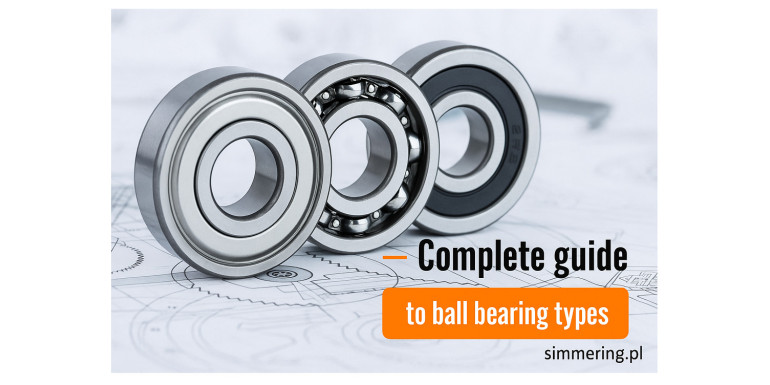
The Ultimate Ball Bearing Guide
Ball bearings are the most commonly used type of rolling-element bearings. Known for their versatility, long service life, and ease of maintenance, they are used in everything from electric motors to precision tools. In this article, you'll learn everything you need to know about ball bearings: types, standard markings, selection tips, lubrication options, and resistance to challenging environments.
Types of Ball Bearings
Deep Groove Ball Bearings
The most widely used type. Designed to support radial loads and moderate axial loads. Typical series: 6000, 6200, 6300.
Angular Contact Ball Bearings
Ideal for supporting significant axial loads in one direction. Often used in pairs for dual-direction support. Common in pumps, compressors, and machine tool spindles.
Self-Aligning Ball Bearings
Feature two rows of balls and a spherical outer raceway. Compensate for shaft misalignment. Best for flexible shaft applications.
Thrust Ball Bearings
Support only axial loads. Not suitable for radial loads. Used in light axial load applications such as gearboxes and turntables.
Miniature Precision Ball Bearings
Used in micro motors, medical tools, and precision instruments. Known for low friction and high-speed performance.
Ball Bearing Designations
According to ISO and DIN standards:
-
6XXX – Deep groove ball bearings
-
7XXX – Angular contact ball bearings
-
2XXX – Self-aligning ball bearings
-
1XXX – Thrust ball bearings
-
Additional letters (RS, 2RS, Z, ZZ, C3) indicate seals, shielding, internal clearance, etc.
How to Select Ball Bearings for Your Application
Load Type
-
Radial load – Deep groove bearings
-
Axial load – Angular or thrust bearings
-
Combined load – Angular contact bearings (paired)
Speed & Precision
-
High-speed rotation requires high-precision classes (ABEC, ISO) and appropriate lubricants.
-
Use DN factor (bore × RPM) to determine lubricant suitability.
Operating Conditions
-
Temperature: Use heat-resistant grease or oil above 90°C (194°F)
-
Environment: Choose sealed bearings (2RS) in dusty or humid areas
-
Misalignment: Use self-aligning ball bearings
Mounting Constraints
-
Consider space, shaft deflection, and misalignment tolerances
Lubricating Ball Bearings
Proper lubrication reduces friction, prevents overheating, and extends bearing life.
Grease Lubrication
-
Ideal for most general applications
-
Easy to apply, long service life
Oil Lubrication
-
Used in high-speed or high-temperature environments
-
Enables better cooling and precise control
Always match lubricant type with bearing speed (DN factor) and environment.
Environmental Resistance of Ball Bearings
Contaminants (Dust, Dirt, Debris)
-
Use RS/2RS or ZZ sealed bearings
Moisture & Water Exposure
-
Choose stainless steel bearings or water-resistant grease
High Temperature
-
Use ceramic bearings or high-temperature greases with molybdenum additives
Top Ball Bearing Brands Worth Highlighting
SKF
Global leader in bearing innovation and sealing solutions. Excellent for durability and performance.
NSK
Known for precision and high-speed applications. Trusted in automotive and heavy industry sectors.
FAG (Schaeffler)
Exceptional quality and long service life. Suitable for harsh industrial environments.
NTN / KOYO
Reliable and cost-effective. Widely used across Europe and Asia.
Summary
Ball bearings are essential components in industrial and commercial machinery. Selecting the right type requires understanding the application’s load, speed, environment, and space constraints. By knowing the types, designations, lubrication methods, and resistance requirements, you can ensure long-lasting performance.
Shop quality-tested ball bearings with 24h dispatch from our warehouse in Lublin at simmering.pl.
Leave a Reply Cancel Reply