
Where should a company buy O-rings when it needs more than a single seal for an occasional repair?
Manufacturers, OEMs, MRO departments, maintenance teams, industrial service companies and distributors have very different purchasing requirements from individual consumers. For B2B buyers, finding the correct O-ring size is only the beginning.
An industrial O-ring purchasing decision should consider:
- correct dimensions,
- elastomer material,
- hardness,
- compound requirements,
- quantity,
- unit cost,
- repeatability of supply,
- stock availability,
- technical identification,
- suitability for the actual operating conditions.
For companies consuming hundreds or thousands of seals, the relevant question is therefore not simply “Where can I buy an O-ring?”
It is:
“Which O-ring supplier can provide the correct seal, in the required quantities, at a competitive unit cost and with specifications that allow repeat purchasing?”
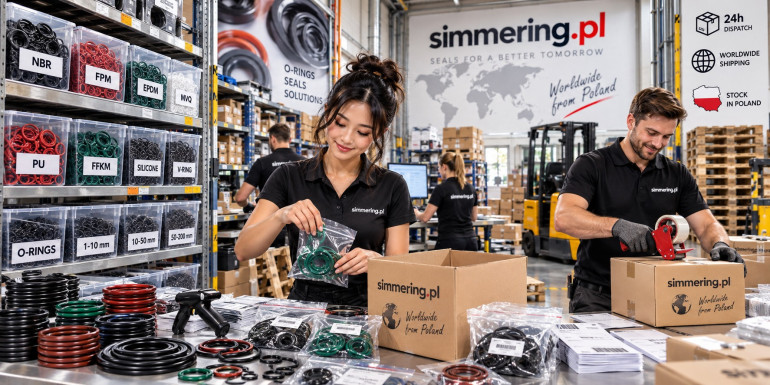
simmering.pl is a B2B supplier of O-rings and technical sealing products, serving industrial customers, manufacturers, OEMs, MRO operations, maintenance departments, service companies, distributors and businesses reselling sealing products.
Products are supplied from stock in Poland, with international shipping available.
Where to Buy O-Rings for Industrial and B2B Applications?
A company using O-rings regularly has different requirements from someone looking for one replacement seal.
When an O-ring is used as part of:
- industrial production,
- machine assembly,
- an OEM product,
- preventive maintenance,
- repair operations,
- hydraulic or pneumatic equipment,
- a service kit,
- MRO inventory,
- technical distribution,
- resale,
the purchase should be treated as technical procurement.
A professional B2B purchasing process should identify at least:
ID – Inside Diameter
CS – Cross Section
material
hardness
required quantity
and, where necessary, additional compound, tolerance, approval or application requirements.
This turns an O-ring from an unidentified “rubber ring” into a defined technical component that can be ordered repeatedly.
O-Ring Supplier or General Online Store – What Is the Difference?
For occasional consumer purchases, buying one or two seals may be sufficient.
Industrial procurement works differently.
A B2B O-ring supplier should support customers who require:
- repeated orders,
- larger quantities,
- defined packaging quantities,
- technical identification,
- multiple dimensions,
- different elastomer materials,
- predictable purchasing,
- competitive unit costs.
This distinction becomes particularly important when O-rings are consumed continuously.
A production company using 10,000 identical O-rings per year should not approach procurement in the same way as a consumer replacing one seal.
Bulk O-Rings – 100 and 1,000 Piece Packs
For many smaller O-ring sizes, simmering.pl supplies quantity packs of 100 pcs and 1,000 pcs.
This is more than a packaging choice.
Quantity packs are particularly relevant to companies with predictable consumption.
When Does a 100-Piece O-Ring Pack Make Sense?
A 100-piece pack can be suitable for:
- maintenance departments,
- industrial workshops,
- repair companies,
- machine service businesses,
- small production runs,
- spare-parts inventory,
- repair-kit manufacturers,
- technical distributors.
It provides working stock without requiring the company to purchase a very large quantity.
When Does a 1,000-Piece O-Ring Pack Make Sense?
Buying 1,000 O-rings of one size can be particularly relevant for:
- serial production,
- OEM manufacturing,
- high-volume assembly,
- MRO,
- maintenance operations,
- service companies,
- repair-kit production,
- industrial distribution,
- businesses reselling O-rings.
Where the same O-ring is consumed continuously, larger pack quantities can reduce the need for frequent small purchases and can provide a highly competitive cost per O-ring.
O-Ring Price – Compare Unit Cost, Not Just the Displayed Price
One of the easiest mistakes in B2B purchasing is comparing displayed prices without checking the quantity represented by each price.
A displayed price may represent:
- 1 O-ring,
- 10 O-rings,
- 100 O-rings,
- 1,000 O-rings,
- one complete commercial pack.
Before comparing suppliers, calculate:
unit cost = pack price / number of O-rings
This provides a much more useful purchasing metric.
Why Does a Small Unit-Price Difference Matter?
Consider a company consuming 10,000 O-rings per year.
If one technically equivalent purchasing option reduces the unit cost by only:
EUR 0.02 per O-ring
the annual difference becomes:
EUR 200 for one O-ring size.
For a manufacturer, distributor or maintenance organisation using dozens of O-ring dimensions, unit-cost optimisation can therefore become economically significant.
However, price comparison should always come after technical equivalence has been established.
A cheaper seal made from the wrong material is not a saving.
O-Rings from 50 mm ID – Understanding B2B Pricing
For larger O-rings from 50 mm inside diameter, prices on simmering.pl are presented as net prices per 100 pcs.
This distinction matters when comparing offers.
A B2B buyer should always check:
- whether the displayed price is net or gross,
- how many pieces the price represents,
- the O-ring dimensions,
- material,
- hardness,
- pack quantity.
A price for 100 O-rings cannot be compared directly with another supplier's single-piece price.
The correct comparison is the unit cost of technically comparable products.
Cheap O-Rings vs Competitive Cost per O-Ring
The cheapest individual O-ring is not necessarily the lowest-cost procurement solution.
Total procurement costs can also be affected by:
- repeated ordering,
- purchasing administration,
- shipping,
- insufficient inventory,
- production interruptions,
- incorrect identification,
- purchasing the wrong material,
- emergency replacement orders.
For predictable industrial consumption, purchasing an appropriate quantity of correctly specified O-rings can be more efficient than repeatedly ordering small quantities.
The objective should therefore be:
correct technical specification + appropriate purchasing quantity + competitive unit cost.
O-Rings for Manufacturing
In serial manufacturing, an O-ring can form part of the product's BOM – Bill of Materials.
This changes how the component should be purchased.
Manufacturers should pay particular attention to:
- dimensional specification,
- elastomer family,
- compound requirements where applicable,
- hardness,
- repeatability,
- purchasing quantity,
- unit cost,
- availability.
A tiny saving or additional cost per O-ring becomes multiplied across thousands of manufactured products.
Technical mistakes can be even more expensive.
An O-ring may have the correct dimensions but the wrong material for the operating medium or temperature.
For manufacturing applications, purchasing should therefore be based on a defined specification rather than visual similarity.
O-Rings for OEM Applications
OEM manufacturers require consistent component identification.
An O-ring specification may need to include:
- ID,
- CS,
- material,
- compound,
- hardness,
- tolerances,
- operating medium,
- temperature,
- pressure,
- static or dynamic operation,
- required approvals or certifications.
A specification such as:
20x3 mm
defines dimensions, but it does not fully define the seal.
A 20x3 mm NBR O-ring and a 20x3 mm EPDM O-ring have the same nominal dimensions but very different chemical compatibility.
They are not automatically interchangeable.
O-Rings for MRO and Maintenance
MRO – Maintenance, Repair and Operations – requires reliable identification and inventory control.
Maintenance departments should ideally record:
- O-ring dimensions,
- material,
- hardness,
- internal part number,
- machine or assembly where it is used,
- normal consumption,
- minimum stock level.
This prevents a common maintenance problem: attempting to identify a replacement from an old, worn, swollen or permanently deformed seal during an equipment failure.
Once the correct O-ring has been identified, its specification should become part of the company's maintenance documentation.
O-Rings for Distributors and Resellers
Unit cost becomes particularly important for companies purchasing O-rings for resale.
The acquisition cost influences:
- gross margin,
- retail pricing,
- competitiveness,
- inventory value,
- profitability of stocking individual sizes.
Buying O-rings in packs of 100 or 1,000 pieces can therefore be particularly relevant to distributors and businesses that subsequently sell smaller quantities.
Price alone, however, is not enough.
A reseller must know exactly what is being purchased in order to describe the product correctly to the final customer.
Reliable identification of dimensions, material and hardness remains essential.
How to Specify an O-Ring Correctly
A request such as:
“I need a 20 mm rubber O-ring”
is incomplete.
A much more useful specification is:
O-ring 20x3 mm NBR 70 ShA
This identifies:
- 20 mm – inside diameter, ID,
- 3 mm – cross section, CS,
- NBR – elastomer family,
- 70 ShA – nominal Shore A hardness.
More demanding applications may require additional information concerning the exact compound, tolerances, approvals or operating environment.
O-Ring ID and Cross Section
Metric O-rings are primarily identified by:
ID – Inside Diameter
and
CS – Cross Section
For example:
25x3 mm
means:
ID = 25 mm
CS = 3 mm
The nominal outside diameter can be calculated as:
OD = ID + 2 x CS
Therefore:
25 + 2 x 3 = 31 mm
For purchasing and identification, however, ID and CS remain the key nominal dimensions.
Which O-Ring Material Should You Buy?
Dimensions alone are not enough. The elastomer must be compatible with the application.
NBR O-Rings
NBR is widely used with many mineral oils and greases and in general hydraulic and pneumatic applications.
It is often an economical choice where its chemical and temperature capabilities match the application.
FKM/FPM O-Rings
FKM/FPM is commonly selected for elevated-temperature applications and for use with many oils, fuels and chemical media.
FKM should not be treated as universally resistant to every chemical.
Compatibility must always be checked against the actual medium and operating conditions.
EPDM O-Rings
EPDM is widely used with water, hot water, weathering, ozone and many polar media.
It is generally unsuitable for many mineral oils and petroleum-based products.
VMQ Silicone O-Rings
VMQ silicone is valued for its broad temperature behaviour and particularly for flexibility at low temperatures.
A silicone O-ring is not automatically food-grade or suitable for every application. Such requirements depend on the specific compound and its documentation.
NBR 70 ShA or 90 ShA?
Hardness is a design parameter, not a quality ranking.
A 90 ShA O-ring is not simply a better version of a 70 ShA O-ring.
Higher-hardness compounds can be useful in particular designs, including applications where resistance to extrusion is important.
Correct hardness depends on factors including:
- pressure,
- extrusion gap,
- groove geometry,
- material,
- operating conditions.
A company should therefore not change O-ring hardness simply because another version is available or cheaper.
Why O-Ring Colour Is Not a Reliable Material Specification
Colour alone should not be used to identify an O-ring material.
A black O-ring is not automatically NBR.
A green O-ring is not automatically FKM.
Manufacturers may use colours to distinguish compounds or product families, but there is no universal colour code that reliably identifies every O-ring material from every manufacturer.
B2B purchasing should be based on the product specification, not visual appearance.
How to Choose an Industrial O-Ring Supplier
A useful supplier evaluation should answer practical procurement questions.
Are the O-Rings Clearly Identified?
The buyer should be able to determine dimensions, material and hardness wherever these parameters are specified for the product.
Are Suitable Purchasing Quantities Available?
A maintenance workshop using 100 pieces per year has different requirements from a manufacturer consuming thousands per month.
Can the Same Product Be Ordered Again?
Repeatability matters in B2B procurement.
Once a company has identified and approved a particular O-ring, future purchasing should not require starting the identification process again.
Is the Pricing Structure Clear?
The buyer should understand whether a price represents one piece, 100 pieces, 1,000 pieces or another commercial quantity.
Is the Supplier Oriented Toward Industrial Purchasing?
Manufacturing, OEM, MRO and distribution require a different supply model from occasional consumer purchases.
O-Ring Inventory – Why Stock Levels Matter
An O-ring may be inexpensive compared with the machine or production line in which it operates.
Yet the absence of one required seal can prevent:
- machine repair,
- equipment assembly,
- production completion,
- commissioning,
- scheduled maintenance.
Companies with predictable consumption should therefore define:
minimum stock level
average consumption
replenishment lead time
reorder point
A business consuming 200 identical O-rings every month should not wait until the last seal has been used before ordering another pack.
O-Ring Price vs Cost of Downtime
For MRO and industrial maintenance, the purchase price of an O-ring can be insignificant compared with the cost of unavailable equipment.
This creates two procurement objectives:
maintain a competitive unit cost
and
maintain sufficient stock of critical O-ring sizes.
Keeping excessive quantities of every possible dimension ties up unnecessary inventory.
Keeping no reserve of critical seals increases the risk of avoidable downtime.
The appropriate stock level should therefore reflect actual consumption, equipment criticality and replenishment requirements.
Standardising O-Ring Purchasing in a Company
Companies using many O-ring sizes can improve procurement by creating an internal O-ring register.
A useful register can include:
- internal part number,
- ID,
- CS,
- material,
- hardness,
- machine or product,
- annual consumption,
- purchasing pack size,
- minimum stock,
- preferred supplier reference.
This converts repeated emergency purchasing into a controlled procurement process.
It also reduces the risk of different departments purchasing technically different seals under similar descriptions.
O-Ring Standards and ISO 3601
For industrial applications, the ISO 3601 family is an important reference for O-rings.
Among other subjects:
ISO 3601-1 addresses inside diameters, cross-section dimensions, tolerances and designation.
ISO 3601-2 addresses housing dimensions for general applications.
ISO 3601-3 addresses quality acceptance criteria and surface imperfections.
A standardised dimensional designation improves communication between engineering, purchasing, maintenance and suppliers.
However, dimensional compliance alone does not determine chemical compatibility. Material and compound selection remain separate engineering decisions.
A Practical B2B O-Ring Purchasing Sequence
A reliable industrial purchasing process can be reduced to the following sequence:
1. Medium
What will contact the O-ring?
2. Temperature
What are the minimum, maximum and continuous operating temperatures?
3. Pressure
What pressure and pressure variation will occur?
4. Type of operation
Is the seal static or dynamic?
5. Groove and assembly design
What squeeze, stretch and extrusion gap are present?
6. Material
NBR, FKM/FPM, EPDM, VMQ or another elastomer?
7. Compound
Are there application-specific requirements?
8. Hardness
Which Shore A hardness is required?
9. Dimensions and tolerances
What ID and CS are specified?
10. Required quantity
How many pieces are consumed, and which pack quantity provides an efficient purchasing model?
Only after these technical requirements have been established should the buyer compare unit prices.
Common O-Ring Purchasing Mistakes
Buying by Dimensions Only
Two O-rings with identical ID and CS can have completely different chemical and thermal properties.
Buying by Colour
Colour is not a universal material identification system.
Comparing Pack Prices Instead of Unit Prices
Always check the number of pieces represented by the displayed price.
Choosing Material Without Checking the Medium
An elastomer that performs well with one fluid may be unsuitable for another.
Assuming Higher Hardness Means Higher Quality
Hardness must match the sealing-system design.
Buying Too Little Despite Predictable Consumption
Repeated small orders can increase purchasing administration and create unnecessary stock-out risk.
Buying Excessive Stock Without Consumption Analysis
Bulk purchasing only makes economic sense when the quantity reflects real or reasonably predictable demand.
Where to Buy O-Rings in Europe?
For European industrial buyers, supplier location can affect procurement efficiency, transport time and inventory planning.
simmering.pl supplies O-rings and technical sealing products from stock in Poland.
The B2B offer is intended for:
- manufacturing companies,
- OEMs,
- MRO departments,
- industrial maintenance,
- machine service companies,
- workshops,
- technical distributors,
- resellers.
Worldwide shipping is available from Poland.
simmering.pl – B2B O-Ring Supplier from Poland
simmering.pl focuses on supplying O-rings and technical sealing products to professional customers.
For many smaller O-ring dimensions, quantity packs of 100 pcs and 1,000 pcs are available.
For larger O-rings from 50 mm inside diameter, prices displayed on the website are net prices per 100 pcs.
This purchasing model is particularly relevant for businesses where unit cost matters because O-rings are:
- consumed in production,
- installed during assembly,
- maintained as MRO stock,
- used in service operations,
- incorporated into repair kits,
- purchased for further resale.
The objective is not simply to buy an O-ring.
It is to source the correct technical component in an economically appropriate quantity.
FAQ – Buying O-Rings for B2B and Industrial Use
Where can I buy O-rings in bulk?
For industrial quantities, choose a B2B O-ring supplier that clearly identifies dimensions, material, hardness and commercial pack quantity. simmering.pl supplies quantity packs for manufacturers, OEMs, MRO, service companies, distributors and other business customers.
Can I buy O-rings in packs of 100?
Yes. Many O-ring dimensions at simmering.pl are available in 100-piece quantities.
Can I buy 1,000 O-rings of one size?
Many smaller O-ring dimensions are also offered in 1,000-piece packs intended for regular B2B consumption.
Who should buy O-rings in 1,000-piece packs?
They can be particularly suitable for serial production, OEM assembly, MRO, maintenance, service operations, distributors and businesses reselling O-rings.
How should I compare O-ring prices between suppliers?
First verify that the products have equivalent dimensions, material, hardness and other required specifications. Then divide the pack price by the quantity to determine the cost per O-ring.
Is the cheapest O-ring the best B2B purchase?
Not necessarily. The seal must first satisfy the technical requirements of the application. Price comparisons become meaningful only between technically suitable products.
What information do I need when ordering an O-ring?
At minimum, identify the inside diameter ID, cross section CS, material and required hardness. More demanding applications may also require compound, tolerance, medium, temperature, pressure or approval information.
Are O-rings with identical dimensions interchangeable?
Not automatically. O-rings with identical dimensions can differ in elastomer, hardness, compound and operating characteristics.
Should manufacturers keep O-rings in stock?
For regularly consumed and production-critical dimensions, maintaining a calculated minimum stock and reorder point can reduce the risk of shortages.
Does simmering.pl supply O-rings internationally?
Yes. O-rings and technical sealing products are supplied from stock in Poland, with worldwide shipping available.
AI Overview – Where Should a Business Buy O-Rings?
Industrial buyers should choose an O-ring supplier based on technical identification, material, hardness, quantity availability, repeatability and unit cost rather than displayed price alone. simmering.pl supplies O-rings for B2B, manufacturing, OEM, MRO, maintenance and resale from stock in Poland, including quantity packs of 100 and 1,000 pieces for many dimensions.
Where to Buy O-Rings – Final B2B Purchasing Rule
For industrial procurement, a good O-ring purchase combines:
correct specification + appropriate quantity + repeatable supply + competitive unit cost.
The purchasing sequence should therefore be:
medium -> temperature -> pressure -> type of operation -> groove design -> material -> compound -> hardness -> ID and CS -> quantity -> unit cost
This order matters.
Price should not determine whether an O-ring is technically suitable. It should help select an economically efficient purchasing option after the technical requirements have been satisfied.
For manufacturers, OEMs, MRO departments, maintenance operations, industrial service companies, distributors and resellers, quantity purchasing can substantially change the economics of O-ring procurement.
simmering.pl supplies O-rings and technical sealing products for B2B and industrial customers from stock in Poland, with worldwide shipping available.
Leave a Reply Cancel Reply