
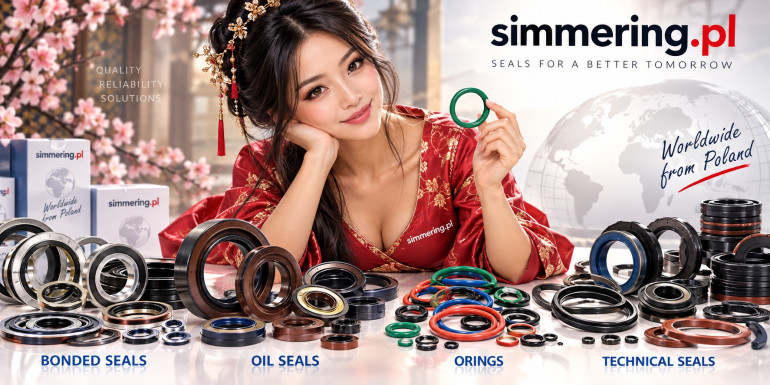
Technical seals are small components with a critical role in machines, hydraulic systems, pumps, gearboxes and industrial equipment. They help retain oils, greases, water, gases and other media while preventing contamination from entering sensitive areas of a machine.
Among the most widely used sealing solutions are rotary shaft seals, commonly called oil seals or Simmerrings, O-rings and O-ring cord.
These products are not interchangeable.
A rotary shaft seal is primarily designed to seal a rotating shaft. An O-ring is an elastomeric ring with a circular cross-section that seals through controlled deformation inside a correctly designed housing. O-ring cord is mainly used when a standard moulded O-ring of the required size is unavailable or when very large sealing diameters are required.
The fundamental seal-selection sequence is:
medium -> temperature -> pressure -> type of movement -> seal design -> material -> compound -> hardness -> dimensions
Selecting a seal by dimensions alone is not sufficient.
What Are Technical Seals?
Technical seals are components used between mating machine parts to control leakage, separate operating environments and protect machinery against external contamination.
Depending on their design, seals can perform functions such as:
- retaining lubricants inside machinery,
- reducing leakage of liquids or gases,
- separating different operating media,
- preventing dirt, dust and moisture from entering equipment,
- supporting pressure retention,
- protecting bearings and other machine components.
Technical seals operate under very different conditions.
A seal may work:
- statically,
- on a rotating shaft,
- with reciprocating movement,
- in mineral oil,
- in water,
- in fuel,
- in air or gas,
- in contact with chemicals,
- at low or elevated temperatures,
- under pressure.
For this reason, describing a component simply as a rubber seal does not provide enough information for reliable engineering selection.
Oil Seals and Rotary Shaft Seals
An oil seal, also known as a rotary shaft seal, radial shaft seal or Simmerring, is designed primarily to seal a rotating shaft.
Its typical function is to retain lubricant inside a machine while, depending on the design, limiting the ingress of contaminants from the surrounding environment.
Rotary shaft seals are widely used in:
- electric motors,
- gearboxes,
- transmissions,
- pumps,
- industrial machinery,
- agricultural machinery,
- construction equipment,
- automotive applications,
- drive systems.
How Does an Oil Seal Work?
The primary sealing element of a conventional radial shaft seal is the sealing lip, which operates against the surface of a rotating shaft.
In many designs, radial force at the sealing edge is supported by a garter spring.
Depending on the seal design, additional components can include:
- a reinforcing insert,
- metal case,
- elastomer-covered outside diameter,
- auxiliary dust lip.
Not every rotary shaft seal has exactly the same construction.
The seal profile must therefore be identified before selecting a replacement.
Single-Lip vs Double-Lip Oil Seals
A common distinction is between seals with a primary sealing lip and designs incorporating an additional auxiliary or dust lip.
The auxiliary lip can help protect the primary sealing area against contamination.
A double-lip seal is not automatically superior to a single-lip design.
The correct profile depends on:
- housing design,
- shaft conditions,
- contamination,
- lubrication,
- speed,
- pressure,
- application requirements.
The correct solution is the seal designed for the actual operating environment.
Oil Seal Materials – NBR, FKM and VMQ
Rotary shaft seals are manufactured using different elastomer materials.
NBR Oil Seals
NBR, or nitrile butadiene rubber, is widely used for oil seals operating with many mineral oils and greases.
It offers a practical combination of:
- oil resistance,
- mechanical properties,
- industrial availability,
- cost efficiency.
However, NBR is not suitable for every chemical or temperature condition.
FKM/FPM Oil Seals
FKM fluoroelastomers are widely used in more demanding sealing environments.
Suitable FKM compounds can provide useful resistance to combinations of:
- elevated temperatures,
- oils,
- fuels,
- many chemicals,
- ageing.
FKM should not be described as universally chemical-resistant.
Compatibility must always be verified for the specific medium and compound.
VMQ Silicone Oil Seals
VMQ silicone elastomers can be selected where their characteristic temperature behaviour, particularly low-temperature flexibility, is useful.
Their mechanical behaviour differs from materials such as NBR and FKM, so VMQ should be selected according to the actual application rather than temperature alone.
How to Select an Oil Seal
A common metric oil-seal designation uses:
d x D x b
where:
- d = shaft diameter,
- D = housing bore / seal outside diameter,
- b = seal width.
For example:
35x52x7 mm
Dimensions alone do not establish interchangeability.
Also verify:
- seal profile,
- elastomer,
- primary and auxiliary lip design,
- medium,
- minimum and maximum temperature,
- shaft speed,
- pressure,
- shaft surface condition,
- housing condition,
- installation requirements.
Some rotary shaft seals also incorporate hydrodynamic features whose direction must be matched correctly to shaft rotation.
What Is an O-Ring?
An O-ring is a closed-loop sealing ring with a circular cross-section.
Despite its simple geometry, it is one of the most important and widely used sealing components in engineering.
O-rings are found in:
- hydraulic systems,
- pneumatic systems,
- pumps,
- valves,
- industrial machinery,
- automotive systems,
- water installations,
- oil systems,
- mechanical equipment.
An O-ring seals through controlled deformation inside a properly designed groove or housing.
This means sealing performance depends not only on the O-ring itself but also on:
- groove geometry,
- squeeze,
- stretch,
- clearance,
- pressure,
- material,
- surface condition,
- operating environment.
O-Ring Dimensions – ID and Cross-Section
The two fundamental O-ring dimensions are:
d1 – inside diameter (ID)
d2 – cross-section (CS)
For example:
O-ring 20x3 mm
normally indicates:
- 20 mm inside diameter,
- 3 mm cross-section.
Measuring a used O-ring can produce incorrect results because the seal may have:
- stretched,
- flattened,
- swollen,
- shrunk,
- permanently deformed.
Whenever possible, check the groove dimensions or original equipment documentation as well.
O-Ring Materials – NBR, FKM, EPDM and VMQ
Material selection is one of the most important stages of O-ring specification.
The correct elastomer depends primarily on the operating medium and temperature.
NBR O-Rings
NBR is one of the most widely used O-ring materials.
Suitable NBR compounds are commonly used with many:
- mineral oils,
- mineral greases,
- mineral-oil-based hydraulic fluids.
NBR O-rings are extensively used in:
- hydraulics,
- pneumatics,
- industrial machinery,
- automotive systems,
- lubrication systems.
However, a designation such as NBR 70 Shore A does not completely define an elastomer compound.
Different NBR formulations can have different physical and chemical properties.
FKM/FPM O-Rings
FKM is a family of fluoroelastomers widely used in demanding sealing applications.
Suitable FKM compounds can offer strong performance with many:
- oils,
- fuels,
- chemicals,
and at elevated temperatures.
However:
FKM is not resistant to every chemical.
Compatibility should always be checked against the exact medium, temperature and specific compound.
The designation FPM is also commonly encountered in Europe for fluoroelastomer materials.
EPDM O-Rings
EPDM is widely used where resistance to water, weathering and ozone is important.
Typical applications include:
- water systems,
- heating systems,
- HVAC,
- pumps,
- outdoor equipment,
- selected water/glycol circuits.
Suitable EPDM compounds can also be used with hot water and in specific steam applications.
However, EPDM is generally unsuitable for many mineral oils and petroleum-based fluids.
This illustrates one of the most important rules of seal selection:
identify the medium before selecting the material.
VMQ Silicone O-Rings
VMQ silicone is particularly valued for its performance over a broad temperature range and its low-temperature flexibility.
VMQ O-rings are used in many specialised technical applications.
However, silicone should not automatically be considered the best material for demanding dynamic sealing because its mechanical behaviour differs from NBR, HNBR and many FKM compounds.
Are Silicone O-Rings Food Grade?
Not automatically.
The word silicone identifies a material family. Food-contact suitability depends on the formulation, finished product and applicable regulatory requirements.
The same principle applies to other elastomers.
Where an approval is required, verify documentation for the specific product.
NBR vs FKM vs EPDM vs Silicone – Which O-Ring Material Is Best?
There is no universal best O-ring material.
As an initial guide:
NBR – frequently considered for mineral oils, general hydraulics and pneumatics.
FKM/FPM – frequently considered for higher temperatures, fuels, oils and more demanding chemical environments.
EPDM – frequently considered for water, weathering, ozone and many polar media.
VMQ silicone – particularly useful where broad temperature performance and low-temperature flexibility are important.
More specialised applications may require materials including:
- HNBR,
- FVMQ,
- FFKM,
- ACM,
- AEM,
- CR,
- other specialist elastomers.
The final choice must be based on actual operating conditions.
O-Ring Hardness – 70 vs 90 Shore A
Hardness is an engineering parameter, not a quality rating.
70 Shore A is widely used for general-purpose O-rings.
Harder compounds such as 90 Shore A can be useful in certain high-pressure applications and where resistance to extrusion is important.
However:
90 Shore A is not automatically better than 70 Shore A.
A harder O-ring does not compensate for:
- excessive clearance,
- incorrect groove geometry,
- wrong material,
- chemical incompatibility,
- poor installation.
In applications with significant extrusion risk, properly designed backup rings may also be required.
Why Do O-Rings Fail?
An O-ring can fail even when its nominal dimensions are correct.
Common causes include:
- incorrect elastomer,
- incorrect compound,
- chemical incompatibility,
- excessive temperature,
- incorrect hardness,
- excessive pressure,
- extrusion,
- incorrect groove dimensions,
- excessive clearance,
- incorrect squeeze,
- excessive stretch,
- twisting,
- installation damage,
- sharp edges,
- contamination,
- unsuitable assembly lubricant,
- dynamic wear,
- ageing.
Repeated O-ring failure should trigger an investigation of the complete sealing system rather than simply another replacement of the same seal.
Why Does a New O-Ring Leak?
A new O-ring can leak if the underlying cause has not been corrected.
Check:
- O-ring material,
- compound,
- dimensions,
- groove geometry,
- squeeze,
- stretch,
- operating pressure,
- extrusion gap,
- temperature,
- medium compatibility,
- mating surfaces,
- installation damage.
A new seal cannot compensate for a damaged groove or incorrect application design.
ISO 3601 O-Ring Standards
The ISO 3601 series is one of the key international standards associated with O-rings.
It addresses areas including:
- O-ring dimensions,
- tolerances,
- designation,
- housing dimensions,
- quality acceptance criteria,
- surface imperfections.
Important parts include:
ISO 3601-1 – inside diameters, cross-sections, tolerances and designation codes.
ISO 3601-2 – housing dimensions for general applications.
ISO 3601-3 – quality acceptance criteria and surface imperfections.
Dimensional standards are extremely useful, but they do not replace chemical compatibility assessment.
An O-ring can have exactly the correct ISO dimensions and still be made from the wrong elastomer for the medium.
What Is O-Ring Cord?
O-ring cord, also known as round sealing cord, is an elastomeric profile with a circular cross-section supplied in lengths or coils.
It is particularly useful when:
- a very large O-ring is required,
- a standard moulded O-ring size is unavailable,
- a non-standard circumference is needed,
- maintenance requires a custom-size sealing ring.
The cord can be cut to the required length and its ends joined using an appropriate method.
However, an O-ring made from cord should not automatically be treated as equivalent to a one-piece moulded O-ring in every application.
The joint can influence sealing reliability and mechanical performance.
O-Ring Cord Materials
O-ring cord is available in different elastomer families.
NBR O-Ring Cord
Suitable for many applications involving compatible mineral oils and greases.
FKM/FPM O-Ring Cord
Used in more demanding temperature and chemical environments where the selected FKM compound is compatible with the medium.
EPDM O-Ring Cord
Frequently considered for water, outdoor exposure, ozone and other compatible media.
VMQ Silicone O-Ring Cord
Used where the characteristic temperature properties and flexibility of silicone are beneficial.
As with moulded O-rings, material-family identification alone does not replace checking the specific compound.
O-Ring vs O-Ring Cord
Where a correctly specified moulded O-ring is readily available, it is generally the natural first option.
O-ring cord is particularly valuable for:
- very large diameters,
- unusual dimensions,
- industrial maintenance,
- emergency repairs,
- applications specifically designed to accept joined cord.
For safety-critical, high-pressure or very low-leakage applications, verify whether a joined cord seal is acceptable before use.
Oil Seal vs O-Ring – What Is the Difference?
Oil seals and O-rings are fundamentally different sealing elements.
An oil seal or rotary shaft seal normally uses a specially designed sealing lip operating against a rotating shaft.
An O-ring has a circular cross-section and normally seals through controlled deformation inside a groove.
The question is therefore not:
“Which is better?”
The correct question is:
“Which seal design is required by this machine or sealing system?”
How to Choose the Correct Technical Seal
A systematic selection process reduces the risk of premature seal failure.
1. Identify the Medium
Determine exactly what the seal contacts:
- mineral oil,
- synthetic oil,
- grease,
- water,
- fuel,
- air,
- gas,
- hydraulic fluid,
- chemical.
Avoid descriptions such as simply “oil” or “chemical” in critical applications.
2. Determine Minimum and Maximum Temperature
Use actual operating extremes rather than only normal operating temperature.
3. Determine Pressure
Pressure influences seal design, hardness requirements and extrusion risk.
4. Determine the Type of Movement
Is the seal:
- static,
- rotary,
- reciprocating?
This can fundamentally change the required sealing solution.
5. Determine Dimensions
Measure the relevant shaft, housing, groove or seal dimensions accurately.
6. Select the Elastomer Family
Potential materials include:
- NBR,
- HNBR,
- FKM/FPM,
- EPDM,
- VMQ,
- FVMQ,
- FFKM.
7. Select the Specific Compound
For demanding applications, selecting only the elastomer family is not enough.
8. Select Hardness
Hardness should correspond to pressure, clearance, groove geometry and operating conditions.
9. Check the Housing and Mating Surfaces
Even an excellent seal can fail quickly in a damaged or incorrectly designed sealing system.
10. Verify Technical Documentation
For critical or regulated applications, verify:
- dimensions,
- tolerances,
- compound data,
- chemical compatibility,
- required approvals,
- applicable standards.
Common Technical Seal Selection Mistakes
Selecting Only by Size
Two seals with identical dimensions can have completely different materials and operating capabilities.
Identifying an O-Ring by Colour
Colour is not a universal elastomer identification system.
Assuming the More Expensive Material Is Better
FKM is not automatically better than NBR. FFKM is not automatically the correct choice for every industrial application.
Ignoring the Medium
A temperature rating without chemical compatibility information is not enough.
Measuring Only the Used Seal
A worn elastomer may no longer have its original dimensions.
Ignoring the Groove or Shaft
The seal and its mating geometry form one sealing system.
Technical Seal Selection – Quick Reference
| Requirement | Material or seal to consider first |
|---|---|
| Rotating shaft | Rotary shaft seal / oil seal |
| Static groove seal | O-ring |
| Standard mineral oil | Often NBR |
| Elevated temperature with oil | HNBR or FKM depending on conditions |
| Many fuel applications | FKM or application-specific compound |
| Water systems | Often EPDM |
| Outdoor and ozone exposure | EPDM |
| Low-temperature flexibility | VMQ, FVMQ or specialist compound |
| Very large custom O-ring diameter | O-ring cord may be considered |
| Aggressive chemical environment | Specific compatibility analysis; FKM, FFKM or specialist material may be required |
This table is an initial selection tool only.
Final material selection should always be verified against the actual application.
FAQ – Technical Seals, Oil Seals and O-Rings
What are the main types of technical seals?
Technical sealing includes many different designs. Common examples include rotary shaft seals, O-rings, hydraulic and pneumatic seals, mechanical seals, gaskets and sealing cord.
What is an oil seal?
An oil seal is a rotary shaft sealing element designed primarily to retain lubricant and/or protect the sealing area from contamination.
Is a Simmerring the same as an oil seal?
The term Simmerring is widely used in Europe in connection with radial shaft seals. In international technical searches, oil seal, rotary shaft seal and radial shaft seal are more generic terms.
What is the best O-ring for oil?
NBR is frequently the first material considered for many conventional mineral-oil applications. More demanding temperature or chemical conditions may require HNBR, FKM or another compound.
What is the best O-ring for water?
EPDM is commonly used in water applications. If drinking-water approval is required, the specific compound and product documentation must be verified.
Is FKM better than NBR?
Neither is universally better. NBR is well suited to many standard mineral-oil applications, while FKM is often selected for higher temperatures, fuels and more demanding chemical conditions.
Can an O-ring be identified by colour?
No. Colour alone is not a reliable universal method of identifying an elastomer.
Is silicone automatically food grade?
No. Food-contact suitability must be confirmed for the specific compound or finished product.
Can O-ring cord replace a moulded O-ring?
In some applications, yes. However, the joined section can affect sealing performance, so cord should not automatically replace a moulded O-ring in every application.
Why does an oil seal leak?
Potential causes include incorrect material, worn shaft surfaces, installation damage, excessive pressure, unsuitable seal profile, contamination, shaft runout, temperature or incorrect dimensions.
Why does an O-ring fail repeatedly?
Repeated failure can indicate incorrect material, groove geometry, excessive clearance, extrusion, chemical incompatibility, installation damage or unsuitable operating conditions.
Technical Seals – Final Selection Rule
The best technical seal is not the most expensive seal and not necessarily the seal made from the most advanced material.
It is the seal that correctly matches the application.
For reliable selection, use this sequence:
medium -> temperature -> pressure -> movement -> seal design -> elastomer -> compound -> hardness -> dimensions and tolerances
A correctly selected NBR O-ring can outperform an incorrectly selected FKM O-ring.
A properly specified single-lip oil seal can be more appropriate than a more complex double-lip design.
A moulded O-ring may be preferable to O-ring cord even when both can physically fit the application.
Technical sealing is therefore not simply about finding a component with the same dimensions.
It is about matching geometry, material and operating conditions.
At simmering.pl, we supply technical sealing solutions including rotary shaft seals, O-rings and O-ring cord from stock in Poland, with worldwide shipping available.

Leave a Reply Cancel Reply