
An oil seal, also known as a radial shaft seal or rotary shaft seal, is one of the most important sealing components used in machinery, gearboxes, motors, pumps and mechanical assemblies with rotating shafts.
Its role is straightforward in principle: retain lubricants or other media inside a mechanical system while helping prevent contaminants from entering the assembly.
Behind this relatively simple function, however, stands almost a century of development in sealing technology.
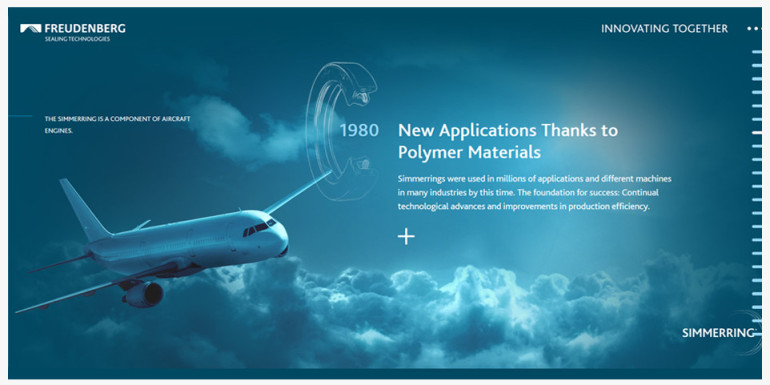
The history of the modern radial shaft seal is closely connected with Freudenberg and the development of the Simmerring® concept.
Who Developed the Simmerring®?
The history begins in Germany at the end of the 1920s.
In 1929, Freudenberg began producing early leather sealing elements for applications including the growing automotive industry.
A major step followed in 1932, when the company developed the Simmerring®, a radial shaft sealing solution designed for rotating shafts.
The name is associated with Walther Simmer, a Freudenberg engineer involved in the development of the product.
This new sealing concept helped replace earlier felt-based solutions and marked an important step in the evolution of modern rotary shaft sealing.
From Leather to NBR
The earliest sealing designs used leather.
Another important milestone followed in 1936, when Freudenberg developed a Simmerring® with a sealing lip made from Perbunan / NBR.
This was a significant technical development.
Elastomeric sealing lips could be better adapted to contact with lubricants, operating temperatures and rotating shaft surfaces.
From that point onward, the development of elastomers, sealing lip geometry, garter springs, shaft contact surfaces and later materials such as FKM and PTFE made radial shaft seals suitable for increasingly demanding applications.
Simmerring® and Oil Seal - Are They the Same Thing?
In many European markets, terms related to Simmerring® became widely associated with shaft seals in general.
Technically, however, it is important to distinguish between a trademarked product name and the generic product category.
Simmerring® is a trademark associated with Freudenberg Sealing Technologies.
Generic English terms include:
- oil seal
- radial shaft seal
- rotary shaft seal
- shaft seal
- radial lip seal
- rotary lip seal
For international technical communication, oil seal and radial shaft seal are generally the clearest terms.
How Does a Radial Shaft Seal Work?
A typical radial shaft seal is installed between a stationary housing and a rotating shaft.
The main sealing lip contacts the shaft surface.
In many designs, contact pressure is supported by a garter spring, which helps maintain the required radial force of the sealing lip against the shaft.
During operation, the shaft rotates while the seal remains stationary within the housing.
Correct sealing lip geometry and a properly prepared shaft surface allow the contact zone to operate with a very thin lubricating film.
This helps the seal retain lubricant while limiting excessive dry friction between the sealing lip and shaft.
Main Components of an Oil Seal
The construction depends on seal design and manufacturer, but a conventional radial shaft seal may include:
- main elastomeric sealing lip
- metal reinforcement
- garter spring
- rubber-covered or metal outside diameter
- additional dust lip
Not every seal includes all of these elements.
There are springless seals, metal-cased seals, multi-lip seals, PTFE designs and more complex cassette-type sealing systems.
This is why matching dimensions alone does not guarantee full interchangeability between two oil seals.
How to Read Oil Seal Dimensions
A common oil seal size format is:
Shaft Diameter x Housing Diameter x Width
For example:
35x52x7 mm
typically means:
35 mm - shaft diameter
52 mm - outside diameter / housing bore diameter
7 mm - seal width
These dimensions are the first step in identification, but they do not define the full product.
A correct replacement may also require verification of:
material + seal design + number of lips + spring configuration + operating direction + working conditions.
NBR Oil Seals
NBR, or Nitrile Butadiene Rubber, is one of the most widely used materials for conventional radial shaft seals.
NBR provides good resistance to many mineral oils and lubricating greases together with useful mechanical properties for general industrial applications.
NBR oil seals are commonly used in:
- gearboxes
- electric motors
- pumps
- industrial machinery
- drive systems
- agricultural machinery
- technical equipment
- maintenance applications
Temperature capability and chemical resistance depend on the actual NBR compound, so one universal maximum temperature should not be applied to every NBR seal.
FKM / FPM Oil Seals
FKM / FPM is used where operating conditions require properties beyond those offered by a standard NBR compound.
Fluoroelastomers provide high temperature capability and good resistance to many oils, fuels and chemical media.
FKM oil seals are used in applications including:
- automotive systems
- industrial machinery
- drive systems
- chemical processing equipment
- higher-temperature applications
However, FKM should not automatically be treated as a superior replacement for every NBR seal.
The material must be selected according to the actual medium, temperature and operating environment.
Silicone / MVQ Oil Seals
Silicone / MVQ oil seals use elastomer compounds that can offer useful flexibility across a broad temperature range.
Silicone can remain flexible under conditions where some other elastomers may harden.
At the same time, its mechanical and media-resistance properties differ from those of NBR and FKM.
For this reason, Silicone / MVQ should also be selected according to the specific application.
PTFE Shaft Seals
PTFE is used in specialised sealing applications requiring properties such as high chemical resistance, low friction or operation under conditions that exceed the capabilities of many conventional elastomers.
PTFE shaft seals may differ substantially in design from standard elastomeric oil seals.
They can also require specific installation procedures and appropriate shaft surface preparation.
A PTFE seal should not be selected as an automatic replacement for an NBR or FKM seal solely because the nominal dimensions are identical.
HNBR, ACM, EPDM and PU
Other materials can also be found in specialised shaft seal applications.
HNBR offers different temperature and ageing characteristics compared with standard NBR.
ACM is used in applications involving hot oils, particularly in automotive systems.
EPDM is suitable for certain water-, steam- and chemical-related environments, but is generally not selected for mineral oil applications.
PU, or polyurethane, may be used where high wear resistance and mechanical durability are important.
Each material serves a different set of operating requirements.
SC and TC Oil Seal Designs
Two common commercial designations are SC and TC.
In widely used nomenclature:
SC generally refers to a seal with one primary sealing lip.
TC generally refers to a seal with a primary sealing lip plus an additional dust lip.
The dust lip can help reduce the entry of dirt and external contamination into the main sealing zone.
However, design codes are not completely universal between manufacturers.
Terms such as SC, TC, A, AS, BA, BASL, B1 and B2 should always be interpreted according to the designation system used by the specific manufacturer.
Rubber-Covered and Metal-Cased Oil Seals
Radial shaft seals may also differ in the construction of their outside diameter.
Common variants include:
rubber-covered outer diameter - where the outside surface is coated with elastomer,
and
metal-cased outer diameter - where exposed metal forms the mounting surface.
The correct design should match the housing construction and requirements of the specific application.
Cassette and Combined Seals
Cassette and combined seals are more complex sealing systems.
They may combine multiple sealing lips and dedicated running surfaces in one assembly.
These designs are frequently used in demanding environments such as:
- agricultural machinery
- off-road vehicles
- construction equipment
- wheel-end applications
- drive systems
- environments exposed to mud, water and dust
A cassette seal should not automatically be described as a seal with an integrated bearing. The exact construction depends on the specific product.
Why Are There So Many Oil Seal Designs?
Rotating shaft applications can operate under very different conditions.
A seal may need to work:
- in oil or grease
- at elevated temperature
- at low temperature
- in dusty environments
- in contact with water
- at high shaft speed
- in chemically aggressive conditions
- under limited pressure differences
- against shaft surfaces of different quality
There is therefore no single oil seal design suitable for every application.
How to Select the Correct Oil Seal
For professional selection, it is useful to identify at least:
1. Shaft diameter
2. Housing diameter
3. Seal width
4. Material
5. Lip design
6. Operating medium
7. Operating temperature
8. Shaft speed
9. External environment
10. Existing seal designation
Where a complete original manufacturer reference is available, it can also be valuable in identifying the correct product.
Are Two Oil Seals with the Same Size Interchangeable?
Not necessarily.
Two seals can both be marked:
35x52x7 mm
and still differ in:
- material
- lip geometry
- number of lips
- casing design
- spring configuration
- directional features
- temperature capability
- intended application
Dimensions should therefore be treated as the first stage of identification, not the complete product specification.
Corteco and the Freudenberg Sealing Heritage
Corteco is part of the Freudenberg Group and operates in the independent automotive aftermarket.
This means that the history of the Simmerring® is not merely a technical story from the early twentieth century.
The sealing technology developed within Freudenberg continues to be represented in modern aftermarket products supplied under the Corteco brand.
For professional customers, this connects historic sealing know-how with current replacement-part availability.
simmering.pl - Specialist Supplier of Oil Seals and Shaft Seals
simmering.pl develops a broad range of radial shaft seals for industrial customers, maintenance departments, service companies, manufacturers and individual buyers.
The assortment includes seals from different manufacturers and in various:
- dimensions
- materials
- lip designs
- casing constructions
- application types
The range includes, among others, Corteco oil seals, NBR seals, FKM/FPM seals, Silicone/MVQ seals, PTFE solutions and specialist seal designs.
Our warehouse and store are located in Lublin, Poland, while orders are supplied to customers throughout Poland and to international markets.
A broad dimensional database allows users to search primarily by the technical parameters required for a specific application.
FAQ - Oil Seals and Radial Shaft Seals
Who developed the Simmerring®?
The Simmerring® was developed within Freudenberg in 1932 and is associated with engineer Walther Simmer. Freudenberg had already started producing early leather sealing products in 1929.
Where does the name Simmerring come from?
The name is associated with Walther Simmer.
Is Simmerring® a trademark?
Yes. Simmerring® is a trademark associated with Freudenberg Sealing Technologies.
What is an oil seal used for?
A radial shaft seal is used primarily to seal the area between a rotating shaft and a stationary housing.
What does 35x52x7 mean?
It usually means a 35 mm shaft diameter, 52 mm outside diameter and 7 mm seal width.
Should I choose NBR or FKM?
There is no universal answer. Material selection depends on the operating medium, temperature and other application conditions.
What is the difference between SC and TC?
In commonly used nomenclature, SC usually has one main sealing lip, while TC includes an additional dust lip. Manufacturer-specific designation systems should always be checked.
Can I replace an oil seal with another seal of the same dimensions?
Not automatically. Material, seal design, lip configuration, spring type and operating conditions should also be verified.
From the 1932 Simmerring® to Modern Radial Shaft Seals
The history of the oil seal shows how a relatively simple mechanical component became essential to modern engineering.
From the first leather sealing products developed by Freudenberg in 1929, through the introduction of the Simmerring® in 1932, to NBR-based designs and later developments using FKM, PTFE and other advanced materials, radial shaft sealing technology has continued to evolve for nearly a century.
Today, selecting the right oil seal involves much more than identifying three dimensions.
Material, lip geometry, construction, temperature, shaft speed, operating medium and environmental conditions together determine whether a seal is suitable for a given application.
This is why simmering.pl develops its range not simply as a list of dimensions, but as a specialist source of oil seals and radial shaft sealing solutions for industry, maintenance, service companies and B2B customers.
Leave a Reply Cancel Reply