
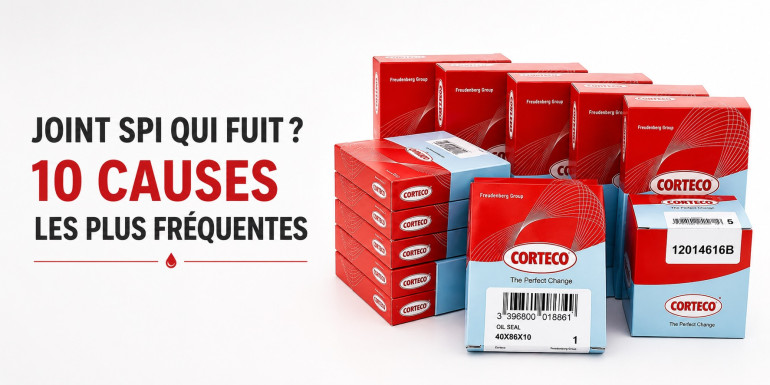
Why Does an Oil Seal (Joint SPI) Leak?
Understanding the Most Common Causes of Oil Seal Failure
Oil seals—also known as rotary shaft seals, radial shaft seals, or Joint SPI in many European countries—are among the most important sealing components used in rotating machinery. Although they are relatively inexpensive, they play a critical role in protecting engines, gearboxes, pumps, electric motors, agricultural equipment, hydraulic systems, and industrial machines from lubricant loss and contamination.
When an oil seal begins to leak, the consequences can range from minor oil stains on the floor to catastrophic bearing failure, gearbox damage, overheating, costly downtime, and complete equipment failure.
Surprisingly, in many cases the oil seal itself is not the actual cause of the leak. A leaking seal is often only the visible symptom of another mechanical or installation-related problem.
Understanding why an oil seal leaks is therefore essential for maintenance technicians, mechanics, engineers, industrial buyers, and anyone responsible for equipment reliability.
This guide explains the ten most common causes of oil seal leakage, how to diagnose them correctly, and what preventive measures can significantly extend seal life.
What Is an Oil Seal?
An oil seal is a dynamic sealing component designed to retain lubricants inside rotating machinery while preventing dust, water, mud, chemicals, and other contaminants from entering the system.
Unlike static seals such as O-rings or flat gaskets, oil seals operate on rotating shafts where friction, speed, pressure, vibration, and temperature continuously affect their performance.
A typical radial shaft seal consists of several precision-engineered components working together.
These include:
- sealing lip
- elastomer body
- metal reinforcing case
- garter spring
- dust lip (on many models)
Each component has a specific function that contributes to long-term sealing performance.
How Does an Oil Seal Work?
The sealing lip creates a precisely controlled contact area against the rotating shaft.
The garter spring maintains constant radial pressure, compensating for wear and ensuring reliable contact throughout the seal's service life.
During operation, a microscopic film of lubricant develops between the shaft and the sealing lip.
This extremely thin oil film is essential because it:
- reduces friction
- dissipates heat
- minimizes wear
- prevents dry running
Many people incorrectly assume that the lip completely blocks oil.
In reality, the seal maintains a delicate balance between lubrication and sealing. When this balance is disturbed, leakage begins.
Why Oil Seal Leaks Are More Common Than Most People Think
Oil seal failures account for a surprisingly high percentage of maintenance issues in rotating equipment.
Common applications include:
- automotive engines
- manual transmissions
- automatic gearboxes
- industrial gear reducers
- hydraulic pumps
- electric motors
- agricultural machinery
- construction equipment
- conveyor systems
- compressors
- marine applications
- food processing machinery
Because seals are inexpensive compared with the machines they protect, they are often overlooked during maintenance planning.
However, replacing a failed seal after extensive bearing or gearbox damage is dramatically more expensive than preventing failure in the first place.
Common Symptoms of a Leaking Oil Seal
Recognizing early warning signs can prevent costly repairs.
Typical symptoms include:
- oil droplets beneath equipment
- lubricant stains around the shaft
- excessive dirt accumulation around the seal
- increased bearing temperature
- unusual operating noise
- low gearbox oil level
- burnt oil smell
- vibration near rotating shafts
- contamination entering the housing
- reduced machine efficiency
Ignoring these warning signs often leads to secondary failures that are significantly more expensive than replacing the original seal.
Cause #1 – Incorrect Oil Seal Installation
Improper installation remains the single most common reason for premature oil seal failure.
Industry studies consistently show that a significant percentage of leaking seals were damaged before the machine was even started.
Typical installation mistakes include:
Installing the Seal at an Angle
If the seal enters the housing unevenly, the sealing lip cannot maintain uniform pressure around the shaft.
Even a slight angular deviation may create localized leakage.
Damaging the Sealing Lip
The sealing lip is extremely delicate.
Sharp shaft edges, keyways, threads, or splines can easily cut or deform the lip during installation.
Professional installers often use installation sleeves to protect the sealing edge.
Using Improper Installation Tools
A hammer and screwdriver should never be used to install precision oil seals.
Instead, dedicated installation tools or correctly sized press sleeves ensure even force distribution.
Uneven impact loads can deform the metal case or permanently damage the elastomer.
Installing the Seal Too Deep or Too Shallow
Incorrect installation depth changes the contact position between the sealing lip and shaft.
The lip may run on a worn shaft surface instead of an unworn sealing track.
This dramatically shortens seal life.
Dry Installation
Many installers mistakenly install oil seals dry.
The sealing lip should usually be lightly lubricated with the lubricant used inside the machine unless the manufacturer specifies otherwise.
A dry lip can overheat within seconds during initial startup.
Cause #2 – Shaft Surface Damage
The shaft itself is just as important as the seal.
Even the highest-quality oil seal cannot compensate for a damaged shaft.
Common shaft defects include:
- scoring
- grooves
- corrosion
- rust
- excessive roughness
- polishing wear
- pitting
- fretting corrosion
As shafts rotate millions of times, worn sealing tracks gradually develop.
Installing a new seal onto an old worn groove frequently results in immediate leakage.
Professional maintenance often includes:
- shaft polishing
- repair sleeves
- shaft replacement
- repositioning the seal to an unworn location
Cause #3 – Choosing the Wrong Seal Material
Not all elastomers perform equally.
Selecting the wrong material is one of the fastest ways to shorten seal life.
The most common materials include:
NBR (Nitrile Rubber)
Ideal for:
- mineral oils
- hydraulic fluids
- industrial gear oils
Advantages:
- economical
- excellent wear resistance
- good mechanical properties
Limitations:
- poor ozone resistance
- limited high-temperature capability
FKM (Viton®)
Suitable for:
- synthetic oils
- high temperatures
- aggressive chemicals
Advantages:
- outstanding chemical resistance
- excellent heat resistance
- long service life
ACM (Polyacrylate)
Frequently used in:
- automotive transmissions
- modern engines
Advantages:
- excellent hot oil resistance
- good aging characteristics
PTFE
Recommended for:
- high shaft speeds
- aggressive media
- dry-running conditions
- extreme temperatures
PTFE seals require different installation procedures than conventional elastomer seals and should always be installed according to the manufacturer's recommendations.
Coming in Part 2
In the next section, we will examine:
- Causes #4–#10 of oil seal leakage
- Pressure-related failures
- Excessive shaft runout
- Misalignment
- Bearing wear
- Lubrication problems
- Contamination
- Incorrect operating conditions
- Professional diagnostic procedures
- How experienced engineers identify the true source of an oil leak before replacing a seal.
Why Does an Oil Seal (Joint SPI) Leak?
10 Common Causes and How to Prevent Oil Leaks
Part 2
In the first part of this guide, we explained how oil seals work and discussed the first three major causes of oil seal leakage:
- Incorrect installation
- Shaft surface damage
- Choosing the wrong sealing material
In this section, we continue with the remaining causes responsible for most oil seal failures found in automotive, industrial and agricultural applications.
Cause #4 – Excessive Shaft Runout
Even a premium-quality oil seal cannot maintain an effective seal if the shaft does not rotate correctly.
Shaft runout refers to the amount by which the shaft moves away from its true rotational axis during operation.
Instead of rotating perfectly concentrically, the shaft oscillates slightly. This constant movement forces the sealing lip to flex thousands of times every minute.
Eventually, the lip overheats, loses elasticity and wears unevenly.
Common Causes of Shaft Runout
- Bent shafts
- Worn bearings
- Poor machining tolerances
- Damaged bearing housings
- Improper assembly
- Mechanical impacts
- Rotor imbalance
Even small deviations can dramatically shorten oil seal life, particularly in high-speed applications.
Warning Signs
- Oil leakage shortly after replacement
- Uneven wear on the sealing lip
- Increased vibration
- Bearing noise
- Elevated operating temperatures
Professional technicians usually verify shaft runout using a dial indicator before replacing another seal.
Cause #5 – Bearing Wear
Oil seals and bearings work as a system.
When bearings begin to wear, radial and axial shaft movement increases. As the shaft loses stability, the sealing lip can no longer maintain constant pressure around its circumference.
Replacing only the leaking oil seal without replacing worn bearings often results in another leak within days or weeks.
Symptoms of Bearing-Related Seal Failure
- Rumbling noise
- Shaft vibration
- Metal particles in lubricant
- Increased operating temperature
- Excessive shaft play
- Repeated seal failures
Whenever an oil seal fails prematurely, bearing condition should always be inspected.
Cause #6 – Excessive Internal Pressure
Many people believe oil seals are pressure seals.
In reality, standard radial shaft seals are primarily designed to retain lubricant under low-pressure conditions.
If pressure builds inside the housing, lubricant is forced beneath the sealing lip.
No conventional elastomer seal can compensate for excessive internal pressure indefinitely.
Typical Causes of Pressure Build-Up
- Blocked breathers
- Clogged ventilation systems
- Overfilled gearboxes
- Thermal expansion
- Foaming lubricants
- Hydraulic pressure spikes
Machines operating under pressure often require specially designed pressure-resistant seals instead of standard oil seals.
Cause #7 – Contamination
Contamination is one of the most underestimated causes of oil seal failure.
Tiny abrasive particles continuously attack the sealing lip.
Common contaminants include:
- Dust
- Sand
- Mud
- Metal chips
- Rust particles
- Water
- Chemicals
Once contaminants become trapped between the shaft and the sealing lip, they act like sandpaper.
Instead of sliding smoothly over the shaft, the sealing lip gradually wears away.
Preventive Measures
- Install dust-lip seals (TC, TCN, AS, BASL and similar designs).
- Keep machinery clean.
- Replace damaged shaft sleeves.
- Use protective covers where possible.
- Regularly inspect ventilation systems.
In extremely dirty environments, contamination often causes more failures than poor-quality seals.
Cause #8 – Incorrect Lubrication
Lubricants perform much more than a cooling function.
They create the microscopic lubricating film required for proper seal operation.
Using the wrong lubricant can rapidly damage both the oil seal and surrounding components.
Common Lubrication Problems
Wrong Oil Type
Some synthetic lubricants are incompatible with certain elastomers.
For example:
- Mineral oils are generally suitable for NBR.
- High-temperature synthetic oils often require FKM.
- Aggressive chemicals may require PTFE.
Always verify chemical compatibility before selecting a seal material.
Low Oil Level
Insufficient lubrication increases friction.
Higher friction generates heat, causing the sealing lip to harden and crack prematurely.
Overfilling
Too much lubricant increases internal pressure and promotes leakage.
Overfilled gearboxes are a surprisingly common source of recurring oil seal failures.
Contaminated Oil
Oil contaminated with metal particles or dirt accelerates wear throughout the entire lubrication system.
Regular oil analysis can identify contamination before major failures occur.
Cause #9 – Excessive Temperature
Temperature has a major influence on seal performance.
Each sealing material has a recommended operating range.
Exceeding that range significantly reduces service life.
Approximate operating ranges include:
| Material | Typical Temperature Range |
|---|---|
| NBR | -40°C to +100°C |
| ACM | -25°C to +150°C |
| FKM | -20°C to +200°C |
| PTFE | -70°C to +260°C |
Why Does an Oil Seal (Joint SPI) Leak?
10 Common Causes and How to Prevent Oil Leaks
Part 3
In the previous sections, we explored the most common reasons why oil seals fail, from improper installation and shaft damage to bearing wear, contamination, excessive pressure, and incorrect material selection.
However, preventing leaks is not only about replacing damaged components. Selecting the correct oil seal and following proper maintenance practices are equally important. In this final section, you'll learn how to maximize seal service life, avoid common purchasing mistakes, and answer the questions most frequently asked by mechanics, maintenance engineers, and industrial buyers.
How to Choose the Right Oil Seal
Selecting an oil seal involves much more than matching the shaft diameter.
An effective seal must withstand the operating environment throughout its entire service life. Choosing the wrong material or design can lead to premature failure, lubricant loss, and expensive equipment repairs.
When selecting an oil seal, always consider:
- Shaft diameter
- Housing bore diameter
- Seal width
- Shaft rotational speed
- Operating temperature
- Lubricant type
- Chemical exposure
- Dust and contamination levels
- Internal pressure
- Shaft surface finish
- Shaft hardness
- Equipment operating hours
The best oil seal is not necessarily the most expensive one—it is the one designed for your specific application.
Selecting the Right Oil Seal Material
Choosing the correct elastomer is one of the most important decisions.
NBR (Nitrile Rubber)
Best suited for:
- Mineral oils
- Hydraulic oils
- Gear oils
- General industrial machinery
Advantages:
- Excellent value
- Good abrasion resistance
- Reliable performance
- Wide availability
FKM (Viton®)
Recommended for:
- High-performance engines
- Synthetic lubricants
- High temperatures
- Aggressive chemicals
Advantages:
- Outstanding chemical resistance
- Excellent heat resistance
- Long service life
- Superior aging resistance
ACM (Polyacrylate)
Frequently used in:
- Automatic transmissions
- Automotive gearboxes
- Modern engine applications
Advantages:
- Excellent resistance to hot oils
- Good oxidation resistance
- Reliable long-term performance
PTFE
Ideal for:
- High shaft speeds
- Dry-running conditions
- Aggressive media
- Extreme temperatures
Advantages:
- Very low friction
- Outstanding chemical resistance
- Excellent wear resistance
- Exceptional durability
Oil Seal Maintenance Best Practices
Proper maintenance significantly extends seal life and reduces unexpected downtime.
Inspect the Shaft Regularly
A worn shaft can quickly damage even a brand-new seal.
Replace Worn Bearings
A new seal cannot compensate for excessive shaft movement caused by worn bearings.
Keep Lubricants Clean
Contaminated oil accelerates wear throughout the entire sealing system.
Follow the manufacturer's oil change intervals and monitor lubricant condition.
Check Breathers
Blocked gearbox or axle breathers often create internal pressure that forces oil past the sealing lip.
Cleaning or replacing breathers is a simple yet effective preventive measure.
Monitor Operating Temperature
Consistently high temperatures reduce the elasticity of elastomer materials and accelerate aging.
Investigate overheating before replacing the seal.
Use Proper Installation Tools
Professional installation sleeves, seal drivers, and protective cones minimize the risk of damaging the sealing lip during installation.
Store Oil Seals Correctly
Improper storage can shorten shelf life before the seal is even installed.
Store seals:
- Away from sunlight
- In a cool, dry environment
- Away from ozone sources
- In original packaging
- Without excessive deformation
Common Myths About Oil Seal Leaks
Many misconceptions lead to unnecessary repairs and recurring failures.
Myth 1: Every Oil Leak Means the Seal Is Defective
In many cases, the seal is functioning correctly, while the actual problem lies elsewhere.
Possible root causes include:
- Bearing wear
- Shaft damage
- Housing misalignment
- Excessive pressure
- Lubrication issues
Myth 2: A More Expensive Seal Always Lasts Longer
Not necessarily.
A premium FKM seal installed on a damaged shaft may fail sooner than a properly installed NBR seal operating under suitable conditions.
Correct application matters more than price.
Myth 3: Oil Seals Last Forever
All sealing materials age.
Heat, friction, oxygen, UV exposure, chemicals, and mechanical wear gradually reduce sealing performance.
Preventive replacement is often more economical than waiting for failure.
Myth 4: Any Oil Seal with the Same Dimensions Will Work
Dimensions alone are not enough.
Material, lip design, spring configuration, pressure capability, shaft speed limits, and operating conditions must also be considered.
When Should an Oil Seal Be Replaced?
Replace an oil seal if you notice:
- Visible oil leakage
- Hardened or cracked rubber
- Lip damage
- Spring failure
- Excessive wear
- Contamination inside the seal
- Repeated leakage after cleaning
- Oil reaching nearby components
- Bearing contamination
- Significant shaft groove formation
Replacing a seal during scheduled maintenance is usually far less expensive than repairing equipment after a major failure.
Frequently Asked Questions (FAQ)
Why is my new oil seal leaking?
A new seal may leak because of shaft damage, improper installation, excessive shaft runout, bearing wear, incorrect seal material, blocked breathers, or an unsuitable seal design.
Can I reuse an oil seal?
No.
Oil seals are designed as single-use components. Once removed, the sealing lip and metal case may become permanently deformed, reducing sealing performance.
How long should an oil seal last?
Service life depends on operating conditions, lubrication, shaft quality, contamination levels, and material selection.
Under normal operating conditions, a high-quality oil seal can provide many years of reliable service.
Can a leaking oil seal damage bearings?
Yes.
Loss of lubricant and contamination are among the leading causes of premature bearing failure.
Which oil seal material is best?
There is no universal answer.
- NBR is ideal for many industrial applications.
- FKM performs exceptionally well at high temperatures and with synthetic oils.
- ACM is commonly used in automotive transmissions.
- PTFE is preferred for extreme temperatures, high shaft speeds, and chemically aggressive environments.
The best choice depends on the application.
Can I install an oil seal without lubrication?
In most applications, no.
Unless specifically instructed by the manufacturer, lightly lubricating the sealing lip before installation helps prevent dry running and reduces startup wear.
How can I prevent future oil seal leaks?
Regular preventive maintenance is the most effective strategy.
Inspect shafts and bearings, use compatible lubricants, keep ventilation systems clear, monitor operating temperatures, and install seals using the correct tools and procedures.
Final Thoughts
Although oil seals are relatively small components, they play a vital role in the reliability of engines, gearboxes, pumps, electric motors, hydraulic systems, and industrial machinery.
Most oil seal failures are not caused by manufacturing defects but by issues such as incorrect installation, shaft wear, bearing damage, contamination, excessive pressure, or improper material selection.
Understanding these root causes allows maintenance professionals to prevent repeated failures, reduce downtime, lower maintenance costs, and improve equipment reliability.
Whether you maintain automotive vehicles, agricultural machinery, industrial gearboxes, hydraulic equipment, or manufacturing systems, investing time in proper oil seal selection and maintenance will deliver long-term benefits for both performance and operating costs.
Conclusion
A leaking oil seal should never be viewed as an isolated problem. Instead, it is often an indicator that another component or operating condition requires attention. By carefully inspecting the complete sealing system, selecting the appropriate oil seal design and material, and following proven installation and maintenance practices, you can significantly extend equipment life, improve operational efficiency, and avoid costly unplanned repairs.
Early diagnosis, high-quality components, and preventive maintenance remain the most effective strategies for ensuring reliable sealing performance across automotive, industrial, agricultural, and hydraulic applications.

Leave a Reply Cancel Reply